Choosing an architecture for a SaaS product is a delivery decision before it is a technology preference. The useful outcome is an architecture your team can build, operate, and change while it learns what customers need.
This guide is for founders and product leaders planning a new SaaS product, rebuilding an early application, or evolving an existing one. Use it to select a modular monolith, serverless functions for selected workloads, or a deliberate hybrid for the next product milestone rather than an imagined end state.
Before you start
Gather the information that materially affects the architecture decision before comparing frameworks or cloud services. Architecture cannot resolve an unclear product boundary or an undefined operating model.
- The primary user journeys that must work in the next release.
- The core business data and the points where related changes must succeed together.
- Known integrations, scheduled jobs, file processing, notifications, and reporting needs.
- Expected workload patterns, including work triggered by events or uneven demand.
- The people responsible for deployment, monitoring, incident response, and change review.
- Constraints involving customer isolation, sensitive information, auditability, or third-party dependencies.
Keep inputs specific. “We need to scale” is not yet a decision criterion. “Users upload files that must be validated and processed without holding open their browser request” describes a workload that a team can design and test.
Step 1: Map the SaaS product into bounded capabilities
Separate product capabilities before deciding deployment units. A capability is a coherent area of product behavior, such as account administration, subscription management, order processing, reporting, or an external-system integration. A capability is not automatically a microservice, database, or serverless function.
Start with a primary user journey. A B2B SaaS customer might invite a colleague, configure a workspace, submit a request, review an outcome, and export a report. That journey can reveal capabilities such as identity and access, workspace configuration, the core workflow, notifications, reporting, and exports. Then identify the data each capability creates, reads, or changes.
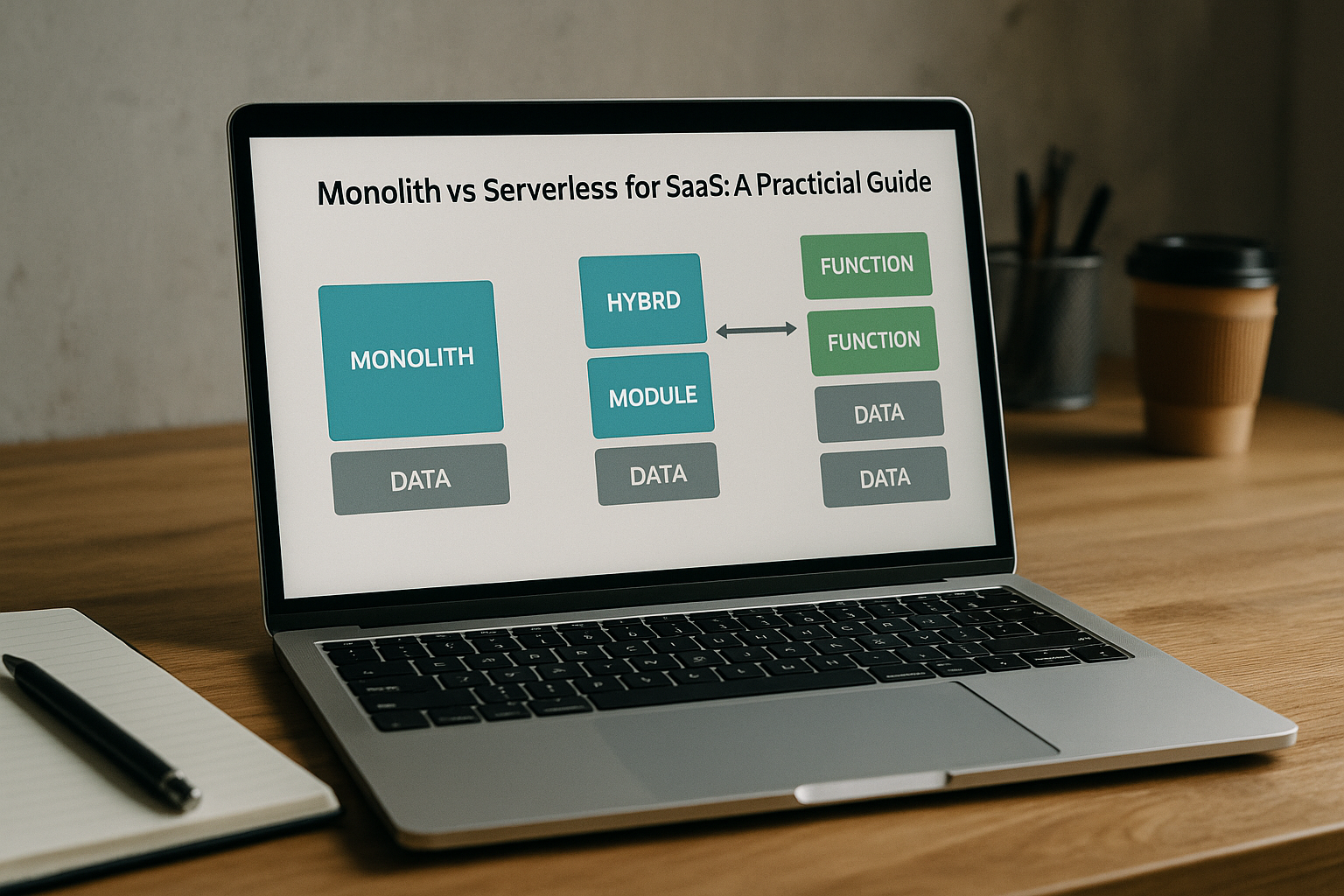
For this guide, a modular monolith is one deployable application organized internally into modules with explicit responsibilities. A serverless function is an independently deployed unit of execution invoked by a request, schedule, or event through a cloud platform. These patterns can coexist because a product boundary and a deployment boundary do not have to be identical.
Record four items for every capability:
- Owner: the product area and engineering responsibility for changes.
- Inputs and outputs: the request, event, or data change that starts work and the result it produces.
- Data boundary: the records it reads or writes and the changes that need coordinated handling.
- Failure behavior: what users, operators, and dependent systems should see when work is delayed, unavailable, or partly complete.
This exercise helps a team avoid turning every noun in a product brief into a separately deployed component. It also clarifies whether a capability should be custom software at all. Where the decision is whether to build or adopt an automation capability, use Exitech’s framework for build versus buy in workflow automation alongside the architecture review.
Step 2: Compare monolith vs serverless for SaaS operationally
Choose an operating model your team can support now. A modular monolith keeps application code, deployment coordination, local development, and debugging in one primary system. A serverless approach places execution across independently deployed functions and cloud-managed triggers. The important question is where the team will perform the operational work, not which label sounds more modern.
Ask practical questions. Can a developer run the core workflow locally? Can the team trace one customer request through every component it reaches? Can a release be tested against realistic dependencies? Who receives an alert, investigates a failure, and decides whether to retry, compensate, disable an integration, or roll back?
A modular monolith can be an appropriate starting point when one team is changing closely connected workflows quickly. It should still have internal module boundaries: avoid arbitrary cross-module database access, keep interfaces explicit, and place third-party adapters at the edge of the application. This keeps a later extraction possible without paying the cost of distributed communication before the product boundary is understood.
Serverless can fit a task with a stable input, a defined output, and a clear failure path. Inbound webhooks, scheduled reconciliations, document conversion, and notification delivery are examples a team may assess. A function still needs tests, logs, access controls, alerts, and an owner for downstream failures.
For AI-assisted SaaS workflows, the operating model also needs explicit governance. Microsoft describes responsible AI considerations including fairness, reliability and safety, privacy and security, inclusiveness, transparency, and accountability.[1] NIST’s AI Risk Management Framework is a useful reference for organizing AI risk review and measurement across a product lifecycle.[2]
As the operating model becomes more complex, decision rights and technical accountability need to be explicit. Exitech’s guide to a fractional VP Engineering engagement covers the leadership question that often accompanies architecture, delivery standards, and technical-roadmap decisions.
Step 3: Classify workloads instead of choosing one architecture everywhere
Assign a pattern to each workload. A SaaS application commonly contains more than one kind of work. Workload classification makes a hybrid architecture intentional rather than accidental.
- Interactive request-response workflows: user actions requiring an immediate, understandable result.
- Transactional workflows: actions that update related business records, such as submitting an order or changing an approval state.
- Asynchronous processing: work that can continue after a user receives confirmation, such as generating exports or sending notifications.
- Scheduled jobs: recurring work such as planned synchronization, clean-up, or summaries.
- Event-driven integrations: work started by an inbound webhook, completed payment, or change in another platform.
- Variable-demand tasks: isolated work that may arrive unevenly and should not obstruct the core user experience.
An early SaaS product might keep onboarding, permissions, workflow state, and billing-related records in a modular monolith while using separately invoked functions for webhook intake, document conversion, or scheduled imports. The decision should rest on a stable boundary, a defined failure response, and the team’s ability to operate the component.
Where an AI or large-language-model feature processes customer input, asynchronous execution alone is not a security control. OWASP’s guidance for LLM applications identifies risks including prompt injection, sensitive-information disclosure, supply-chain issues, excessive agency, and insecure output handling.[3] Record what data can enter the workload, what tools it can call, what output requires review, and what actions output is permitted to trigger.
Step 4: Evaluate data and integration boundaries
Decide where consistency and recovery belong before splitting code. Architecture risk often becomes visible at a boundary between data stores, services, or third parties. If a workflow updates a customer record, creates an invoice, and sends a notification, define what outcome is authoritative when one action succeeds and another does not.
For each cross-boundary interaction, document the source of truth, the identifier used to correlate activity, retry behavior, and the reconciliation path. Design integrations so repeated delivery can be recognized and handled safely. Define how a delayed event is prevented from silently replacing a newer customer decision. These are requirements to test rather than assumptions to leave in queue configuration.
For multi-tenant SaaS, establish where tenant identity is created, how it travels through background work, and how operational records remain useful without exposing customer information. Treat an external provider as a dependency with its own failure modes, release timing, and data contract.
For machine-learning workflows, Google Cloud’s MLOps guidance addresses automated validation, deployment controls, monitoring, and continuous improvement rather than treating model release as a one-time activity.[4] Apply equivalent operational thinking whether an AI capability runs inside the main application or behind an event-driven boundary.
Step 5: Choose the smallest architecture that supports the next milestone
Make the decision for the next meaningful product milestone. Select the smallest architecture that supports the workflows to be validated and the operational obligations already present. Keep the choice reversible by preserving clear internal interfaces and documenting the assumptions behind it.
For an early SaaS MVP
Consider a modular monolith when the core workflow is still being discovered, one team owns most changes, and data relationships are evolving. Organize code by capability, establish a repeatable deployment path, and add structured logs and basic operational checks. Keep potential extraction points visible in module interfaces, but do not add remote calls solely in anticipation of a future state.
For a workflow-heavy B2B platform
Keep the stateful workflow and its permissions close to the transactional data. Assess queues or independently invoked tasks for clearly asynchronous work such as exports, notification delivery, or inbound integration processing. Give users a visible status model—such as accepted, processing, complete, or needs attention—rather than leaving them with an indefinitely waiting request.
For an integration-led product
Consider isolation around external systems when each integration has distinct credentials, failure modes, or release timing. Preserve a consistent internal domain model instead of allowing a provider’s data shape to spread through the whole application. Define replay and reconciliation before the integration becomes central to a customer workflow.
For an established application with a concentrated concern
Extract selectively when a specific module has a persistent, observable reason: a distinct scaling requirement, an independently changing integration boundary, a reliability-containment need, or a separate ownership model. Measure the concern, define the new interface, and assign operational responsibility before moving the component. Replacing an entire application architecture is not required to address one bounded problem.
If the product question includes whether a managed automation product can replace custom work, revisit the build-versus-buy workflow automation framework. The architecture should follow the work the product must own and the responsibilities the team is prepared to retain.
Step 6: Write an architecture decision record and migration triggers
Document the choice in a short architecture decision record. The record should be understandable to product, engineering, and operations stakeholders, and it should remain useful when original assumptions change.
- Decision: for example, a modular monolith for core workflows with serverless processing for inbound webhooks and scheduled exports.
- Context: the user journeys, constraints, and workload patterns considered.
- Consequences: what the decision simplifies, what must be operated, and what is intentionally deferred.
- Ownership: responsibility for deployments, alerts, dependency changes, and incident decisions.
- Observability: the logs, metrics, traces, and business-status checks needed to investigate failed work.
- Migration triggers: observable conditions that justify extracting or redesigning a component.
A migration trigger describes a condition rather than a hope. “Review reporting extraction when it needs independent release ownership and its data-access contract is defined” creates a testable review point. “Extract when we scale” does not. AWS’s Machine Learning Lens includes operational excellence, security, reliability, performance efficiency, cost awareness, and lifecycle governance among its considerations for machine-learning workloads.[5] Comparable criteria can guide reviews of an AI-related component’s current boundary.
Verification checklist
- The selected architecture supports the next product milestone and named user journeys.
- Every core capability has an owner, data boundary, and defined failure behavior.
- Asynchronous and event-driven workloads have retry, user-status, and reconciliation handling.
- The team can test, deploy, observe, and investigate the chosen components.
- Tenant context, sensitive-data handling, and third-party dependencies have been considered.
- The decision record names a review point and specific migration triggers.
Common mistakes
- Treating serverless as automatically simpler. Managed execution can still create distributed paths that require testing and observability.
- Treating a monolith as inherently unsuitable. A modular monolith can be a deliberate stage-appropriate choice when its constraints fit the workload and team.
- Splitting before boundaries are understood. Separate deployments do not create a coherent domain model or data contract.
- Ignoring operational ownership. An independently deployed component still needs accountability for access, alerts, failures, and changes.
- Writing vague migration plans. Use observable signals and defined interfaces rather than generic promises to revisit architecture later.
Next action
Turn this assessment into a one-page architecture decision record and review it with the people accountable for product scope, engineering delivery, and operations. If you need help translating SaaS workflows into a scoped build plan and maintainable cloud architecture, talk to Exitech about the delivery decisions your product needs to make next.
References
- Microsoft, Responsible AI principles and approach: https://www.microsoft.com/en-us/ai/principles-and-approach
- National Institute of Standards and Technology, AI Risk Management Framework: https://www.nist.gov/itl/ai-risk-management-framework
- OWASP, Top 10 for Large Language Model Applications: https://owasp.org/www-project-top-10-for-large-language-model-applications/
- Google Cloud, MLOps: continuous delivery and automation pipelines in machine learning: https://cloud.google.com/architecture/mlops-continuous-delivery-and-automation-pipelines-in-machine-learning
- AWS, Machine Learning Lens: https://docs.aws.amazon.com/wellarchitected/latest/machine-learning-lens/machine-learning-lens.html
Leave a Reply