Blog

  • How AI Is Changing: From Helpful Prompts to Governed Business Workflows

    AI is changing from a system that primarily generates answers into one that can assist with defined tasks, use context and, in some cases, act through software; the business evidence still shows that most use is augmentation rather than minimal-human-involvement automation.

    Start with the change that matters: AI is moving from conversation toward action

    Widely accessible large language models (LLMs), including ChatGPT, made AI useful to a broad audience because they could respond to questions in surprisingly humanlike language using patterns learned from very large quantities of data. An LLM is a model designed to generate and work with language. That capability remains useful for drafting, summarising, brainstorming and finding information, but it is only one layer of the current shift. [1]

    The next layer is commonly called agentic AI: systems intended to respond to and act on their environment in real time, rather than only produce text. The idea is not entirely new. IBM’s history traces earlier approaches from specialised computational components working in parallel, through agents that searched a defined puzzle space, to expert systems that combined a knowledge base with an inference engine. Those systems were narrow: Stanford’s MYCIN, for example, could diagnose bacterial infections and recommend antibiotics in specified areas, while expert systems depended on people hand-coding new information and struggled outside their fixed knowledge bases. [1]

    The practical distinction is straightforward. A conversational system can turn notes into a first draft. A task-oriented system can work through a defined sequence: receive information, select an approved next step, produce a structured output and pass it to another system or person. An agentic workflow adds the possibility of interacting with business software, such as navigating screens, entering information or retrieving a result. It does not remove the need to define the permitted action, the information available to the system and the point at which a person must approve the outcome.

    Understand why modern AI behaves differently from rule-based software

    Machine learning is the process of finding patterns in observations that explain and predict the consequences of events and actions, with the aim of improving future performance. Modern AI is dominated by artificial neural networks and deep learning rather than the rule-based expert systems associated with earlier AI. Deep learning refers to methods based on neural networks with multiple layers; a historical review dates the first working deep-learning algorithms from 1965 onward. [2]

    This difference matters in business terms. Rule-based software follows instructions that have been explicitly specified. Machine-learning systems can work from learned patterns and supplied context, which makes them more adaptable for language, documents and varied inputs. It also means a business process cannot be made reliable merely by assuming that a fluent response is a correct one. The older expert-system lesson remains relevant: fixed logic had clear limits outside its knowledge base, and learned systems require equally clear boundaries around the work they are permitted to perform.

    Research during the 2000s shifted agent work from symbolic reasoning toward behaviour learned from data. Reinforcement-learning agents, recommendation systems, web crawlers and trading agents demonstrated a practical model of perceive, decide and act at scale. In 2013, a DeepMind paper demonstrated one neural-network agent learning seven Atari games at human-comparable levels directly from pixels. These milestones explain why current systems can be designed around workflows rather than solely around static rules. [3]

    Separate useful assistants from autonomous workflows

    Businesses can usefully organise AI work into three levels. The first is personal assistance: drafting communications, summarising documents, brainstorming or researching information. The second is task assistance: taking a recurring input, producing a defined deliverable and leaving a person to review or complete the next step. The third is workflow automation: a system moves through multiple steps with minimal human involvement. These are different operating models, not interchangeable descriptions of the same capability.

    The distinction is visible in the U.S. Chamber of Commerce Foundation and Ipsos survey of small-business workers. Among AI users, 64% identified personal productivity as the primary application, 26% used AI for recurring tasks and 6% used it to automate workflows with minimal human involvement. Workers who used AI and performed the relevant tasks reported especially high use in writing and editing communications, research and information gathering, technical and coding work, and creative work such as design. [4]

    That evidence supports a practical starting point: choose work that has a repeatable input, an identifiable output and an accountable reviewer. A communications workflow, for example, can use AI to create an initial draft from approved source material, then route it to a designated reviewer before it is sent. A document workflow can use AI to extract and organise material for review, rather than treating the extracted result as final. A coding workflow can use AI to assist with technical work while retaining a defined review step before the work is accepted. These uses preserve the advantage of speed without redefining an unreviewed output as a completed business decision.

    Where human checks belong

    Human checks belong at the transition from assistance to consequence: before information is committed to a business record, before an external communication is issued, before a software action is completed and whenever a workflow would otherwise proceed with minimal human involvement. The available evidence does not identify a universal list of tasks that can safely run without review. It does show that minimal-human-involvement automation is much less common than productivity assistance in the small-business survey, while privacy or security concerns were the most frequently named adoption barrier at 47%. [4]

    A useful control is to specify four points in writing for each workflow: the approved input, the permitted output, the person who reviews the result and the action the system may take after approval. This turns “use AI” into an operational design. It also makes it possible to distinguish an experiment that helps a worker from a workflow that changes how the organisation handles information or actions.

    Measure adoption accurately instead of treating AI as one number

    AI adoption is growing, but it is neither universal nor equally deep across organisations. Nationally representative data from the 2026 AI supplement to the U.S. Census Bureau’s Business Trends and Outlook Survey found that, from November 2025 to January 2026, 18% of firms used AI in at least one business function; the employment-weighted figure was 32%. Firms expected adoption to reach 22% within six months. Use was concentrated in large firms and knowledge-intensive sectors, reaching 50% to 60% of very large firms in Information, Professional Services and Finance. [5]

    The same study shows why a single adoption percentage can mislead. Among firms already using AI, 57% used it in three or fewer business functions. Sales and Marketing was the most common function at 52%, followed by Strategy at 45% and IT at 41%. At the worker level, AI use appeared in 23% of firms, or 41% when weighted by employment, primarily for writing, document analysis and information search; 65% of those firms limited use to three or fewer tasks. The study also found both top-down and bottom-up diffusion: workers may use AI where the company has not adopted it, while a company may adopt AI without worker use. [5]

    For an Exitech reader, the relevant measurement is therefore not simply whether AI exists somewhere in the business. It is the number of functions involved, the number of tasks actually in use, where employees are using tools independently and where an approved workflow has been designed. The small-business worker survey illustrates the governance gap: 19% said employee exploration mostly drove adoption at their organisation, compared with 11% who cited organisational guidance or direction. It also reported lower work-task use among businesses with two to nine employees, at 43%, than among businesses with 100 to 249 employees, at 59%. [4]

    Focus on augmentation, then test whether outcomes improve

    The strongest current pattern is augmentation, not wholesale replacement. In the NBER analysis, 66% of firms used AI to help with tasks, while 2% reported employment reductions. Its regression results showed a positive relationship between firm performance and the breadth of AI integration. The same analysis associated deployment across business functions and operational investment with employment declines, while worker task use was not associated with employment declines after those factors were controlled for. These are distinct findings: a relationship with broader integration is not a guarantee that any single tool or task will produce a particular result. [5]

    The International Labour Organization’s review reaches a similarly measured conclusion. Drawing on experiments, firm-level data, platform studies and worker and firm surveys from Australia, Denmark, Germany, Korea, Kuwait, the United Kingdom and the United States, it found that generative AI productivity gains are real but often unverified and uneven. Large-scale job displacement has remained limited, and worker-reported time savings of a few per cent of working hours have not yet translated into higher measured output, earnings or employment. [6]

    The operational implication is to evaluate a workflow after it is in use, rather than treating time saved in one step as proof of an overall performance gain. A review can compare the intended task with the resulting output, the review effort required and whether the workflow is used across more than one defined function. This is also where human checks provide information: they reveal whether the AI output is useful enough to move a task forward or simply shifts work into correction and coordination.

    Prepare for delegation without confusing it with independence

    Some work is already being delegated from people to AI. In an Epoch AI and Ipsos survey of 1,106 employed U.S. adults, 20% of respondents said AI handled at least one task they had previously given to a coworker or contractor. The most common reported shifts were analysing data, at 7.1% of respondents; reading work documents, at 5.7%; and maintaining records, at 5.3%. [7]

    Delegation is not independence. A system may perform part of a task while a person remains responsible for deciding whether its output is fit for use and whether a next action is permitted. This distinction is particularly important as agents become more capable of operating interfaces. Adept’s ACT-1 demonstration in September 2022 showed a model operating web browsers and software interfaces from plain-language commands, and the October 2022 ReAct paper proposed combining language-model reasoning with actions and environmental observations. Together, these developments help explain the trajectory toward software-operating agents. [3]

    Build an AI programme around defined work, controls and evidence

    A practical AI programme begins with a short inventory of existing use, including individual employee use and formally deployed tools. It then separates personal productivity tools from recurring task workflows and minimal-human-involvement automation. For each recurring workflow, document the input, output, reviewer, approval point and any software action. Keep privacy and security concerns visible: they were the leading barrier in the small-business worker survey, while lack of clarity about business relevance and skills gaps were each named by 41% of workers. [4]

    The trends worth watching are therefore concrete: AI spreading across a broader set of business functions; employee-led use becoming visible alongside leadership-led adoption; assistants handling writing, documents and information work; and agents gaining the ability to interact with software. The headline to avoid is the assumption that action-capable AI makes oversight unnecessary. The current evidence describes limited scope in many firms, uneven productivity effects and a much larger role for task assistance than for unattended automation.

    Exitech can help map current AI use, identify appropriate business workflows, define human approval points and put practical governance around adoption. A consultation can turn scattered experimentation into a controlled programme built around the work that matters.

    References

    1. IBM, “The evolution of AI agents.”
    2. arXiv, “Annotated History of Modern AI and Deep Learning.”
    3. Agentic History, “History of AI agents.”
    4. U.S. Chamber of Commerce Foundation, “Half of Small Business Workers Use AI.”
    5. National Bureau of Economic Research, “AI Diffusion Across U.S. Firms.”
    6. International Labour Organization, “The Impact of GenAI on Jobs, Productivity and Work Organization.”
    7. Epoch AI, “One in Five Workers Delegate Work to AI.”

  • Software Engineering Metrics for Product Teams

    Software Engineering Metrics for Product Teams

    Software engineering metrics should help a product team make better operating decisions: whether a release needs more work, where delivery is slowing down, which reliability risk deserves attention, and whether an improvement changed the system. This guide is for founders, product leaders, and engineering managers who need that visibility without creating a dashboard full of numbers nobody uses.

    The outcome is a small, decision-oriented scorecard for delivery flow, reliability, quality, and operational context. It is not an employee ranking system, a substitute for customer research, or evidence that one number explains product performance. Used well, metrics give the team a shared starting point for investigating the software and service users depend on.

    Engineering metrics describe how software is planned, changed, released, supported, and maintained. Product analytics addresses different questions about user behavior in the product. Keep the two disciplines connected through release context, but do not treat them as interchangeable.

    Before You Start

    Set up the scorecard only after the team can name the decisions it needs to support. Bring together product, engineering, and the person accountable for delivery, then agree on a narrow initial scope.

    • Identify the product outcome or release decision under review.
    • Map the workflow from planned work through code, release, incident response, and support.
    • Confirm who owns each source of data and who will facilitate the review.
    • Choose one recurring forum where the team can discuss trends and decide actions.
    • Write down the scope assumptions for the release or initiative.

    A documented scope keeps the scorecard connected to agreed work. Teams working from a roadmap can also use the release practices described in From Roadmap to Release: A Product Engagement Built Around Continuous Delivery to clarify how planned changes move toward production.

    Do not start by selecting a reporting tool. A tool can collect events and display charts, but it cannot determine which operating question matters most.

    Step 1: Start With the Decision, Not the Dashboard

    List the recurring decisions the team must make, then attach a possible signal to each one. This reverses a dashboard-first approach: instead of collecting every available measure, choose measures that can influence a specific action.

    For example, a team deciding whether a release is ready might review unresolved release-blocking defects, open production incidents, the age of unfinished work, and agreed acceptance checks. No single signal declares a release ready. Together, they make uncertainty and risk visible to the people responsible for the decision.

    A different team may be deciding whether reliability work should take priority over a feature. In that case, incident records, recurring support themes, changes requiring remediation, and engineering observations are likely to be more useful than a broad productivity chart.

    Write each decision as a question

    • Where is work waiting longer than the team expects?
    • What is preventing a safe and supportable release?
    • Which recurring production problem should be investigated first?
    • Is the team accumulating unfinished work or rework?
    • What evidence would justify changing process, scope, architecture, or staffing?

    For every question, record the possible response. If the group cannot explain what it might do after a metric moves, leave that metric out. This keeps partner oversight focused on delivery evidence, assumptions, and decisions rather than appearances.

    Step 2: Define Software Engineering Metrics Categories

    Use four categories to view the delivery system without treating one category as the whole story. Define terms locally and keep each definition stable over time.

    Flow metrics

    Flow metrics describe how work moves through delivery. Useful examples include lead time for changes, work-item age, review-queue age, deployment frequency, and work in progress. A team might define lead time for changes as elapsed time from an agreed code-change starting point to deployment. Work-item age might mean the time an item has remained unfinished after active work began.

    Use these measures to investigate waiting, oversized work, unclear handoffs, or constrained review capacity. They do not establish why a pattern exists or prove that a faster process is better. Review the trend with the people doing the work.

    Reliability metrics

    Reliability metrics describe production behavior and the response when a service does not behave as intended. Examples include change failure rate, time to restore service, incident count by category, and recurring incident themes. Define a change failure explicitly: for example, a deployment that is rolled back, needs an urgent corrective change, or causes a recorded incident. Do not silently change that definition between reporting periods.

    For AI-enabled product functions, assign risk-review ownership and use a repeatable lifecycle process. The NIST AI Risk Management Framework describes a framework for governing, mapping, measuring, and managing AI risks.[1]

    Quality and customer-impact signals

    Quality signals can include escaped defects, rework themes, failed acceptance checks, support requests, and findings from release or incident reviews. Define an escaped defect as a problem found after a change reaches the environment being measured, usually production. Define support themes through an agreed ticket or conversation taxonomy.

    These signals should lead the team back to the affected workflow and user context. A defect count does not describe user impact on its own, and a quiet support queue does not establish customer satisfaction.

    Context signals

    Record the conditions surrounding delivery alongside the numbers: planned versus unplanned work, dependency waits, team changes, migrations, or new compliance requirements. These annotations help the team interpret a trend without pretending that a chart contains its own explanation. Avoid using system-level measures to judge individual contributors; they describe a workflow shaped by many conditions.

    Step 3: Build a Minimum Viable Scorecard

    Start with a limited set of measures across flow, reliability, quality, and context. A practical first scorecard might include deployment frequency, lead time for changes, change failure rate, time to restore service, work-item age, escaped defects, and recurring support themes.

    These are examples, not universal targets. Establish the team’s own baseline before deciding whether movement is meaningful. Product maturity, release practice, service risk, and operating constraints all affect interpretation.

    Document every metric before reporting it

    Create a one-page definition for each measure. Include:

    • Name: the plain-language metric name.
    • Decision supported: the operating choice it informs.
    • Formula: the exact calculation or counting rule.
    • Time window: the period included in each review.
    • Data source: the system of record and relevant fields.
    • Owner: the person accountable for maintaining the definition.
    • Exclusions: work or events deliberately left out and why.
    • Known blind spots: what the measure cannot establish without other evidence.

    For an AI-enabled capability, extend the scorecard beyond delivery speed. AWS’s Machine Learning Lens addresses operational excellence, security, reliability, performance efficiency, cost optimization, and sustainability considerations for machine-learning workloads.[2] Select measures and review questions that reflect the particular feature rather than assuming standard web-service measures are sufficient.

    A scorecard can also provide operational evidence for a broader technical due diligence review for SaaS, alongside architecture, security, documentation, and ownership review.

    Step 4: Instrument the Workflow Before Reporting

    Map each measure to a source system and validate the data path before scheduling a review. A delivery workflow may include a planning tool, version-control system, continuous integration and delivery service, incident-management process, monitoring platform, and customer-support system.

    For each source, define the events that count. Decide which work-item statuses represent active work, when a pull request enters and leaves review, which deployment event is authoritative, and how an incident is opened and closed. Tag releases and incidents consistently enough to connect a production issue to a relevant service or change when appropriate.

    Prioritize data hygiene before dashboard polish. A work item left open after completion or an incident classified differently by each responder changes the meaning of the metric. Run a small sample audit: select reported items, trace them to source records, and confirm that the calculation matches the written definition.

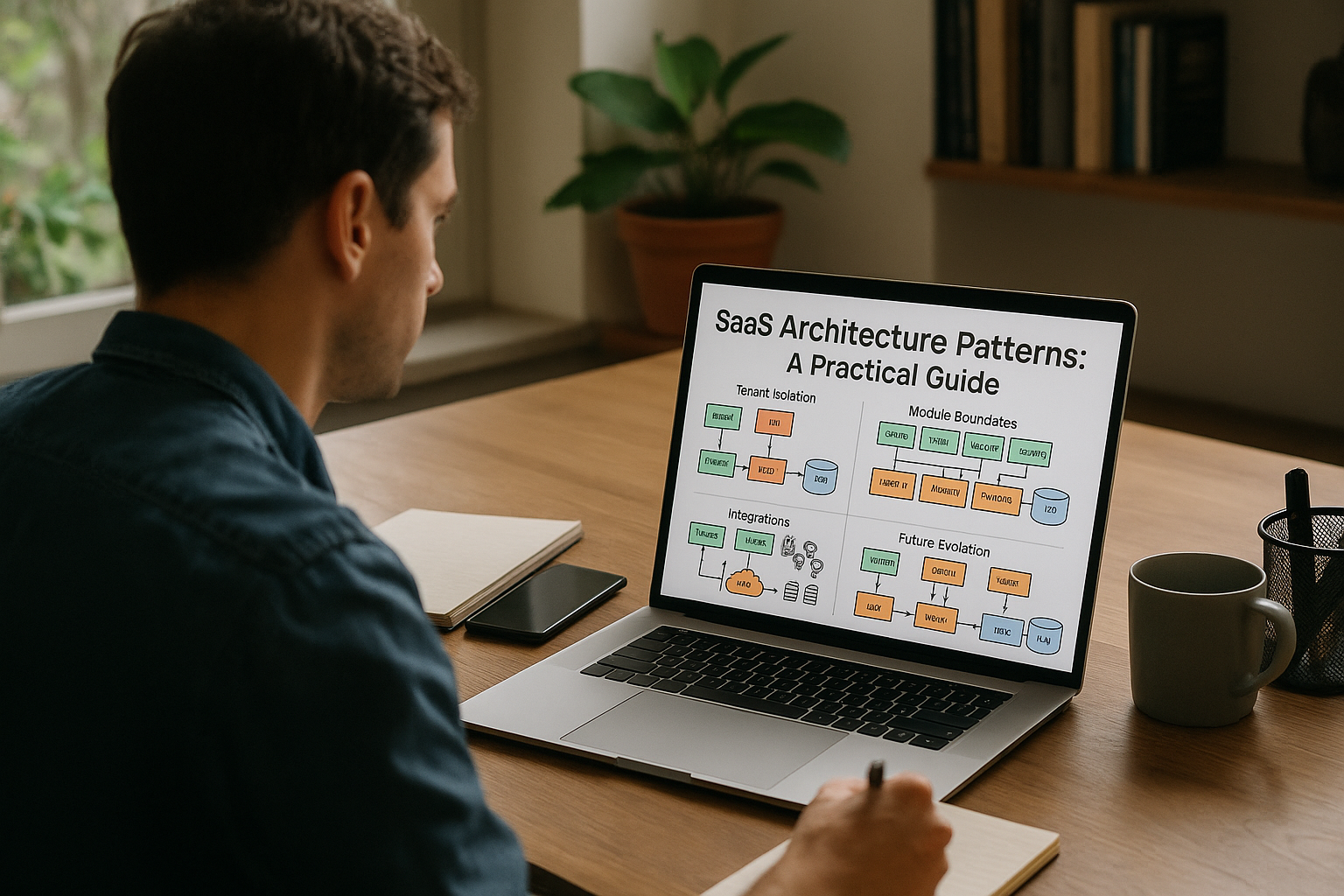
    Metric scope should match the service and ownership boundaries being reviewed. Teams clarifying those boundaries can use SaaS Architecture Patterns: A Practical Guide alongside the scorecard process.

    For machine-learning systems, Google Cloud describes MLOps as including automated validation, delivery pipelines, deployment controls, monitoring, and continuous improvement rather than treating model release as a one-time event.[3] Record the controls and review points your product actually uses.

    Step 5: Review Trends With Operational Context

    Review scorecard trends on a fixed cadence, then investigate changes before assigning a cause. Compare each measure with the team’s historical baseline. One reporting period may reflect an unusual release, dependency delay, migration, or incomplete data rather than a durable operational change.

    Use a simple review sequence: identify what changed, locate where it changed, record relevant context, and decide what evidence would confirm or challenge the first explanation. Review release notes, incident findings, support themes, workflow observations, and customer feedback alongside the chart.

    Segment data only when the segment supports a decision. A team may need to separate planned work from urgent production work, or one service from another. Avoid comparisons between unlike teams, products, or risk profiles. The purpose is learning about a system, not producing a league table.

    Step 6: Add Feature-Specific Review for AI-Enabled Functions

    Where an AI feature is in scope, add operational signals that reflect its particular risks. Include relevant security findings, evaluation failures, rollback or remediation events, and user reports of unsafe behavior in the review process. Assign an owner for investigating those signals and deciding whether a release, prompt, model configuration, or workflow needs to change.

    OWASP identifies prompt injection, sensitive-information disclosure, supply-chain vulnerabilities, excessive agency, and insecure output handling among risks for large language model applications.[4] Microsoft identifies fairness, reliability and safety, privacy and security, inclusiveness, transparency, and accountability as responsible AI principles.[5] These sources do not provide a universal scorecard. Use them to identify risk areas the product’s existing review may overlook.

    Step 7: Turn Signals Into Bounded Improvement Experiments

    Convert a concerning pattern into one specific experiment with an owner and review date. The objective is not simply to improve a metric. It is to change part of the system, observe the result, and reassess the decision that measure supports.

    If review-queue age rises, the team might trial a defined review rotation, smaller pull-request expectations, and a daily check for blocked changes. Record the owner, start date, expected operational signal, and evidence that would reveal an unintended consequence.

    If release failures repeat, an experiment could add a pre-release validation step for the affected integration and require a documented rollback path. If incidents recur in one service, the experiment might address a specific monitoring gap and create a follow-up item from the incident review.

    Keep experiments bounded. Do not rewrite the entire delivery process because one chart moved. Retain a change when the evidence supports it; revise or stop it when the evidence is weak.

    Step 8: Use the Scorecard in Planning, Launch, and Oversight

    Bring the scorecard into planning and release conversations before risks become delivery surprises. During scope discussions, flow and work-item age can show whether planned work is accumulating faster than completion. During release readiness, reliability and quality signals can frame what remains uncertain.

    Metrics also make technical-debt prioritization more precise. Rather than labeling every older component as debt, connect a candidate investment to observable rework, incident patterns, difficult releases, or a dependency that blocks planned product work.

    When working with a development partner, agree on shared definitions, source access, review cadence, and escalation paths at the start. The most useful report makes current risks, assumptions, and next actions visible. For related guidance on setting expectations and assessing delivery capability, see How to Choose a Software Development Partner: A Practical Guide for Product Teams.

    Use the same approach at handoff: record operating metrics, source systems, active risks, and owners so the receiving team can continue review without reconstructing delivery history.

    Verification Checklist

    • Every metric has a named decision it supports.
    • Every definition states its formula, time window, data source, owner, and exclusions.
    • The scorecard covers flow, reliability, quality, and relevant context.
    • The team has established a historical baseline instead of copying arbitrary targets.
    • Each review includes qualitative evidence such as incident findings, release notes, or support themes.
    • System metrics are not used to rank individual contributors.
    • Every improvement action has an owner, bounded scope, and review date.

    Common Mistakes to Avoid

    • Tracking too many measures: a large dashboard can obscure the decisions that matter.
    • Setting arbitrary targets: a target without product or operational rationale encourages empty optimization.
    • Comparing unlike teams: maturity, service risk, and constraints change the meaning of a number.
    • Hiding definitions: teams cannot trust a metric they cannot reproduce from source data.
    • Optimizing speed alone: faster delivery is not sufficient when reliability, security, or quality evidence points elsewhere.
    • Replacing customer evidence with engineering evidence: a smooth delivery process does not establish that users value the outcome.

    Next Action

    Start with one product decision and a scorecard small enough to review honestly. If you need help defining a delivery workflow, establishing reliable operational signals, or connecting post-launch support to product priorities, talk to Exitech about building a practical engineering operating model alongside the software itself.

    References

    1. https://www.nist.gov/itl/ai-risk-management-framework
    2. https://docs.aws.amazon.com/wellarchitected/latest/machine-learning-lens/machine-learning-lens.html
    3. https://cloud.google.com/architecture/mlops-continuous-delivery-and-automation-pipelines-in-machine-learning
    4. https://owasp.org/www-project-top-10-for-large-language-model-applications/
    5. https://www.microsoft.com/en-us/ai/principles-and-approach
  • Learning Software Engineering in the Era of AI

    Learning Software Engineering in the Era of AI

    Learning software engineering in the era of AI is not a contest to produce code faster than a tool. The more useful goal is to develop the judgment around code: understanding a problem, making constraints explicit, modelling data, checking assumptions, investigating failures, and explaining trade-offs.

    That distinction matters to founders, product leaders, and learners alike. A convincing prototype may be assembled quickly, but a product still needs people who can decide what it should do, identify where it may fail, and take responsibility for it after users depend on it.

    AI-assisted tools can be part of a learning environment. Treat their output as material to inspect, not as authority to accept. A generated explanation, test case, schema, or function can become a useful starting point when the learner can challenge its assumptions, adapt it to the product context, and explain why the final choice is appropriate.

    This article offers a practical framework for developing engineering capability without confusing generated output with engineering understanding.

    Learning software engineering in the era of AI means learning the delivery loop

    Software engineering is broader than making a function appear to work. In a product setting, engineering connects a user need to software that can be reviewed, deployed, observed, maintained, and changed deliberately.

    That work starts before an editor is opened. A broad request must become a defined outcome: who is affected, which action should be possible, what information is required, and what success looks like. The team also needs to decide what happens when information is missing, a dependency is unavailable, or two people act on the same record at once.

    A useful way to approach a learning project is as a chain of responsibility:

    • Frame the problem. Turn a request into a user outcome, boundaries, assumptions, and acceptance criteria.
    • Design the behaviour. Define data, states, interfaces, permissions, failure paths, and the smallest architecture that can support the need.
    • Build and verify. Make small changes, review the logic, and test both expected and unexpected paths.
    • Operate and improve. Investigate defects, record decisions, observe behaviour, and make future changes with care.

    AI can be used at each stage without transferring accountability. Ask for alternative designs, then compare them against stated constraints. Ask for test ideas, then decide which failures matter to users and the business. Ask for an explanation of unfamiliar code, then verify that explanation with documentation, tests, and direct inspection.

    The prompt is not the engineering conversation. It is only one input to it.

    Build foundations that make generated output legible

    AI-assisted development is easier to use responsibly when a learner can read what has been produced. Fundamentals are not a delay before practical work. They provide the vocabulary needed to inspect software, identify risks, and make a change with intent.

    Programming concepts and state

    Start with how values move through a program: inputs, outputs, variables, types, conditions, loops, functions, errors, and state. State is the information a system remembers. In a purchase workflow, for example, a request might be a draft, submitted, approved, rejected, or cancelled.

    Practice reading small pieces of code before asking a tool to produce large ones. Identify each input. Describe what each branch does. Predict which errors may occur and what output should result. Then change one condition and predict the effect before running the program. This habit exposes gaps in understanding before a working-looking result masks them.

    Data, interfaces, and boundaries

    Useful software stores, retrieves, or exchanges information. Learners benefit from understanding data models, validation, application programming interfaces, authentication, authorization, and the boundary between a user interface and server-side behaviour.

    Draw a boundary before writing code. Which part of the system owns a record? Which role may update it? What information may another system receive? What information should remain private? A small diagram and a few written rules can make later implementation choices easier to evaluate.

    These questions are especially useful when reviewing generated code. A shortcut may look tidy while placing authorization in the wrong layer, trusting unvalidated input, or mixing unrelated responsibilities into one component. The learner does not need to reject generated code by default; the learner needs a way to assess it.

    Testing, debugging, and version control

    Testing is the practice of making expected behaviour visible. Begin with a rule or calculation: state what must be true, create an example that checks it, and investigate when the result differs. Add broader checks when multiple components must work together.

    Debugging follows a similarly disciplined path. Reproduce the issue with the smallest useful example. Gather evidence. Form a hypothesis. Change one thing. Verify whether the result addresses the original problem without introducing a new one. Asking an AI tool for possible causes can be useful, but the tool should not replace the evidence-gathering step.

    Version control supports this way of working. Small, descriptive changes are easier to reason about. A focused change request gives a reviewer a manageable unit to assess. A clear commit message can preserve why a decision was made after the original discussion is gone.

    Use AI as a sparring partner, not an authority

    A productive learning pattern is active rather than passive. Instead of asking an AI system to create an entire feature and accepting the result, give it a bounded task and make verification part of the exercise.

    Consider a form that collects a customer request. A learner could ask for several approaches to validation. The next step is not to copy the shortest snippet. It is to compare the approaches: Where does validation run? What happens if browser checks are bypassed? Does the server apply the same rule? How is an error communicated? Can another engineer understand and maintain the decision?

    Use a repeatable workflow:

    1. Write expected behaviour first. Describe the user action, inputs, desired result, and meaningful failure cases in plain language.
    2. Request a small artifact. Ask for pseudocode, a data model, a test outline, or a limited function rather than an entire application.
    3. Read before running. Identify assumptions, dependencies, permission-sensitive actions, and paths the output does not cover.
    4. Verify independently. Run tests, try invalid inputs, inspect logs or network activity where appropriate, and compare observed behaviour with the expectation.
    5. Explain the decision. Record why an approach was accepted, changed, or rejected. If the decision cannot be explained, it should not yet be relied upon.

    This workflow turns AI output into a source of questions. That is valuable when the objective is learning. A flawed answer can still be useful if the learner can locate the flaw, explain the correction, and add a check that would catch the issue next time.

    Code review can reinforce the same discipline. Ask questions such as: What assumption does this change make? Which test demonstrates the intended behaviour? What would happen if a dependency fails? What makes this difficult to modify later? These questions move review beyond whether a result appears plausible.

    Practice system thinking with product-sized scenarios

    Tutorial exercises are useful for isolated concepts. Product-sized scenarios teach how decisions connect. Choose a narrow workflow with users, data, states, permissions, and failure conditions. The aim is not to make the project large. The aim is to make its boundaries visible.

    Example: an internal approval workflow

    Imagine a simple internal tool for purchase requests. A requester creates a draft, submits it, an approver accepts or rejects it, and an administrator reviews the history.

    Start without code. Which fields are required? Can a submitted request be edited? Who may approve it? What happens if the same request is open in two browser tabs? Must a rejection include a reason? Which events should be available for later review?

    Then model the information. A request could have an identifier, requester, amount, category, status, timestamps, and an approval decision. The permitted status transitions are part of the design: a draft may be submitted; a submitted request may be approved or rejected; an approved request should not silently return to draft status.

    An AI tool may help create a starter schema or propose test cases. The engineering exercise is to inspect the result. Does the proposed structure represent the workflow? Does authorization prevent requesters from approving their own requests? Does the interface reject an invalid state transition? Do the tests cover a missing field, an unauthorized user, and an accidental repeated submission?

    Include operational questions as well. How should a failed submission be communicated to the requester? What information would help a developer investigate a reported issue? Which decisions need to be recorded for a future change? These questions encourage learners to treat supportability as part of the work, not as an afterthought.

    Repeat the exercise with a booking flow, customer dashboard, or dealer onboarding process. Each project can produce artifacts beyond code: a concise problem statement, acceptance criteria, a data sketch, test cases, a decision record, and a short retrospective. Together, those artifacts show engineering reasoning more clearly than screenshots alone.

    Learn responsible AI delivery alongside software delivery

    When a product includes an AI capability, the learning scope expands. The team needs to consider information handling, output evaluation, human review, release decisions, and how it will respond when the feature performs outside expectations.

    The NIST AI Risk Management Framework provides a reference point for thinking about AI risk management across the lifecycle.[1] Microsoft presents fairness, reliability and safety, privacy and security, inclusiveness, transparency, and accountability as responsible AI considerations.[2]

    For learners, these subjects can become concrete design questions:

    • What data enters the feature, and should it be sent to an external service?
    • Which outputs require review before a user acts on them?
    • How will the interface communicate uncertainty, limits, or escalation paths?
    • What information would help the team investigate an incorrect or harmful outcome?
    • Who is accountable for a decision to release, pause, or change the capability?

    Security deserves explicit attention. OWASP’s Top 10 for Large Language Model Applications identifies categories including prompt injection, sensitive-information disclosure, supply-chain risks, excessive agency, and insecure output handling.[3] A practical learning response is to treat untrusted content as untrusted, limit the permissions available to automated actions, validate outputs before they affect other systems, and make sensitive integrations reviewable.

    Production concerns belong in the same discussion. The AWS Machine Learning Lens covers operational excellence, security, reliability, performance efficiency, cost optimization, and sustainability considerations for machine-learning workloads.[4] Google Cloud’s MLOps guidance discusses automated validation, pipelines, deployment controls, monitoring, and continuous improvement for machine-learning systems.[5] The broader lesson for learners is straightforward: a feature should be evaluated as an ongoing responsibility, not merely as a one-time demonstration.

    Build communication skills that make engineering usable

    Engineering quality is often shaped in conversation. A vague request becomes a clear requirement. A shortcut becomes an explicit trade-off. A hard-won lesson becomes documentation that another person can use.

    Practice converting ambiguous requests into questions. “Build an AI assistant” is a starting point, not a requirement. Ask who will use it, which task it supports, what information it may access, what a useful result looks like, and when a person should take over. The answers inform architecture, safeguards, testing, and the user experience.

    Short decision records are a useful communication habit. Record the context, options considered, selected approach, consequences, and unresolved questions. The goal is not ceremony. It is to leave a trail of reasoning for the next engineer, product manager, founder, or support colleague who needs to understand a change.

    For teams, continuous delivery offers a practical setting for these habits: work can be scoped, reviewed, released in manageable increments, and discussed after release. See how a product engagement can be built around continuous delivery for a related delivery perspective.

    A practical learning plan for individuals and teams

    Do not attempt to master every language, framework, or AI tool at once. Build a sequence that moves from concepts to constrained practice to collaborative delivery.

    1. Choose one stack. Learn one language, one application framework, a database, version control, and a testing approach well enough to build a small workflow end to end.
    2. Build one workflow at a time. Select a narrow problem with users, rules, and data. Write acceptance criteria before implementation begins.
    3. Use AI in bounded tasks. Request explanations, alternatives, test ideas, or review prompts. Keep the scope small enough that the result can be examined line by line.
    4. Make verification visible. Keep tests, reproduction steps, and expected behaviour close to the change. Demonstrate a successful path and an intentional failure path.
    5. Invite review. Ask a peer to challenge assumptions and read the work without relying on the original prompt. Revise where the reasoning is unclear.
    6. Reflect after each increment. Note what was misunderstood, which assumption proved weak, and which check could reveal that issue earlier in the next project.

    Founders and engineering leads can apply the same framework when assessing a team or delivery partner. Use a scenario rather than tool familiarity alone. Ask the person to clarify an unclear requirement, sketch a data boundary, identify a failure mode, propose a verification approach, and explain a trade-off.

    The useful assessment question is not simply whether someone can use AI tools. It is whether they can guide AI-assisted work toward a product outcome that a team can understand, operate, and improve.

    Conclusion: develop judgment, then use tools deliberately

    The era of AI gives learners more ways to explore software engineering. It does not remove the need to understand how software behaves, how systems fail, or how users experience the result. It makes disciplined judgment more important because more output can be created before anyone has checked whether it belongs in a product.

    Build foundations. Work through complete but small workflows. Treat generated output as review material. Test assumptions. Document decisions. Include security, privacy, reliability, and accountability in the definition of done.

    The goal is not to compete with AI at typing speed. It is to develop the judgment to use AI deliberately while helping teams build software that can be understood, maintained, and trusted.

    References

    1. https://www.nist.gov/itl/ai-risk-management-framework
    2. https://www.microsoft.com/en-us/ai/principles-and-approach
    3. https://owasp.org/www-project-top-10-for-large-language-model-applications/
    4. https://docs.aws.amazon.com/wellarchitected/latest/machine-learning-lens/machine-learning-lens.html
    5. https://cloud.google.com/architecture/mlops-continuous-delivery-and-automation-pipelines-in-machine-learning
  • Reported Cloud Infrastructure and Data Sovereignty Standards Announcement: A Response Plan for Product Teams

    A reported September 17 announcement says that updated baseline compliance frameworks for digital platforms have been released. For founders, business owners, and product teams, the immediate outcome should be better evidence—not an immediate cloud migration.

    The event brief available for this article does not identify the issuing regulator or consortium, framework text, jurisdictions, legal status, effective date, transition period, or required controls. Those details determine whether the announcement is a voluntary standard, a contractual expectation, binding regulation, or something else entirely. Until an authoritative publication confirms them, treat the announcement as a developing compliance signal.

    This guide gives teams a practical way to respond without claiming obligations that have not been established. The goal is to build a clear view of where data moves, which services and people can access it, which vendors process it, and which technical choices can wait for confirmed scope.

    Before you start

    Collect the evidence already available before interpreting the reported announcement. This is not a request to create a new compliance programme or move every workload to a different region. It is a focused effort to establish a reliable baseline and assign decision owners.

    • A current architecture diagram covering production, staging, development, backup, and recovery environments.
    • An inventory of cloud accounts, projects, subscriptions, services, and configured regions.
    • A list of data categories the product handles and any existing data-classification policy.
    • A vendor, subprocessor, integration, analytics, support, backup, and AI-provider inventory.
    • Customer contracts, data-processing terms, security questionnaires, and public statements about data handling.
    • Named owners from engineering, product, security or risk, and legal or commercial operations where those functions exist.

    If the documentation is incomplete, begin with the same evidence-first discipline used in Technical Due Diligence for SaaS. For this response, keep the scope narrow: data location, copying, access, third-party processing, and contractual commitments.

    Step 1: Confirm what the data sovereignty standards announcement actually says

    Action: Assign one owner to locate the original, versioned announcement and prepare a short applicability note before approving infrastructure changes.

    In this guide, data sovereignty means the governance and legal considerations that may apply to data because of where it is held, how it is controlled, and who can access or process it. It is not simply a cloud-region selection. A product can use a primary database in one location while backups, telemetry, support tooling, administrative access, and downstream vendors create additional processing paths.

    The owner should answer only questions the primary material answers:

    • Who issued the framework, and what authority does that organisation have?
    • Is the document binding, voluntary, contractual, or guidance?
    • Which organisations, products, sectors, jurisdictions, and data categories are in scope?
    • What effective date, transition arrangement, assessment method, or reporting expectation is stated?
    • Does the source address storage, replication, access, suppliers, audit evidence, notification, or another specific control area?

    Record direct quotations, page references, document versions, and publication dates in the note. Keep three separate lists: confirmed statements, interpretations, and unanswered questions. A news report, vendor post, or customer email can point the team toward an announcement, but it cannot establish the framework’s applicability by itself.

    Make a decision record, not a premature verdict

    Create a short decision record containing the source version, review date, owner, systems considered, confirmed implications, assumptions, and next review trigger. This record gives sales, delivery, and engineering teams one defensible account of the current position. It also makes later revisions easier when authoritative implementation guidance becomes available.

    Step 2: Map data residency, replication, and access paths

    Action: Produce a data-flow map for each material product workflow, starting when data enters the product and ending with deletion, archival, or recovery.

    Data residency is the documented location or locations where a system stores data. Replication is the creation of copies for availability, backup, analytics, or recovery. Access is the ability of a person or service to view, change, transmit, or otherwise process data. Separating these concepts prevents an imprecise conclusion such as “the database is in region X, so the whole workflow is covered.”

    For every important data category, record:

    1. How it enters: a web form, mobile application, API, import, support channel, or integration.
    2. The application, database, object store, queue, cache, search index, and file store that handle it.
    3. The configured service region or location, where that information is available.
    4. Copies created through backups, exports, event streams, logs, monitoring, error reporting, and business-intelligence tools.
    5. Human and service access, including operational and customer-support access.
    6. External recipients, such as identity, messaging, payment, analytics, document, or AI providers.
    7. The retention, deletion, and recovery path.

    Start with one representative workflow rather than waiting for complete documentation. That might be a customer registration, an administrator invitation, a support request, a dealer upload, or a transaction. The first map exposes missing inventory data and creates a repeatable format for the remaining workflows.

    Deployment design affects the tracing work. A monolith may concentrate some flows, while serverless and event-driven components can distribute them across managed services and asynchronous events. The guide to monolith versus serverless for SaaS can help teams identify deployment boundaries worth documenting. It does not, by itself, determine a sovereignty conclusion.

    Step 3: Compare confirmed scope with the real operating model

    Action: Build a requirements-to-evidence matrix only after Step 1 identifies a confirmed requirement, scope statement, or customer commitment that merits review.

    Use one row for each confirmed point. Include the affected system, available evidence, accountable owner, current status, decision, and review date. Label a gap only when the evidence shows that the product does not meet a confirmed expectation. Keep assumptions and unanswered questions separate. Combining them can make a planning estimate appear more certain than it is.

    Review the operating model beyond compute and database settings. Examine infrastructure-as-code repositories, cloud configuration, deployment pipelines, network paths, secrets management, observability services, backup jobs, incident-support procedures, and recovery runbooks. Also examine SaaS services that may not be labelled infrastructure, including analytics, communications, session recording, customer support, and document-processing tools.

    For example, a team may have documented its primary database region while still needing to trace error reports containing identifiers, scheduled exports sent to another service, or recovery procedures that rely on unreviewed assumptions. That finding is not a compliance verdict. It is a defined evidence task.

    For multi-tenant products, map shared services as well as customer-specific configurations. For specialised workflows, include staff-facing tools, administrative exports, and support operations. The useful question is not whether a component is visible to an end user; it is whether that component participates in a material data path.

    Step 4: Preserve options with proportionate cloud infrastructure changes

    Action: Prioritise improvements that increase visibility and control, and defer irreversible migration commitments until applicability is confirmed.

    Low-regret work can be useful regardless of the framework’s eventual scope. Examples include versioning infrastructure configuration, documenting service-region settings, reducing unused privileged access, separating environments, recording recovery dependencies, and assigning ownership for exports and scheduled jobs. These actions improve the quality of later decisions without assuming a new standard requires a specific architecture.

    Start by collecting configuration evidence. Record account structures, service settings, region selections, replication settings, access-control assignments, and encryption-key arrangements where relevant. Store point-in-time evidence with a review date. Configuration exports and reviewed infrastructure code are often easier to compare over time than an isolated screenshot.

    Then assess reversibility. Some changes are configuration updates; others need application work, data movement, vendor negotiation, contract amendments, or customer communications. Mark each option as reversible, difficult to reverse, or dependent on external parties. This gives product leaders a concrete basis for sequencing work.

    Use an architecture decision record for each material option: state the problem, confirmed inputs, assumptions, services affected, trade-offs, owner, and reconsideration trigger. SaaS Architecture Patterns: A Practical Guide provides useful context for documenting boundaries and dependencies, while this review remains focused on the announcement’s confirmed scope.

    Review AI-enabled data paths separately

    If product data reaches a model, retrieval system, or AI provider, map that route explicitly rather than treating it as a generic API integration. Microsoft describes privacy and security as part of its responsible AI approach.[1] That is a useful prompt to identify AI data paths; it does not establish the requirements of the reported announcement.

    For AI-enabled workflows, inventory prompts, retrieved records, uploads, outputs, logs, evaluation data, provider configuration, and access roles. AWS publishes its Machine Learning Lens as architecture guidance for machine-learning workloads.[2] Google Cloud’s MLOps guidance also addresses automation across validation, deployment, and monitoring activities.[3] Use these materials as operational context, not as evidence that a particular sovereignty obligation applies.

    Step 5: Review vendors, contracts, and customer statements

    Action: Create one vendor review worksheet and compare it with commitments already made to customers.

    For each material provider, capture the service used, data categories involved, configured locations, listed subprocessors where available, access model, retention settings, export capability, notification terms, and contract owner. Where vendor documentation does not answer a decision-critical question, request clarification. Do not infer an answer from a provider’s headquarters, product name, or the location of a nearby cloud region.

    Review customer agreements and completed security questionnaires alongside the vendor worksheet. Identify statements about data location, cross-border processing, support access, audit rights, retention, backups, and notification. Ambiguous commercial language should be assigned for legal or commercial review rather than translated into an engineering assumption.

    AI and automation suppliers need the same disciplined review. OWASP’s Top 10 for Large Language Model Applications identifies security risks including sensitive-information disclosure, supply-chain risk, excessive agency, and improper output handling.[4] Those risks are not a substitute for data-sovereignty analysis, but they reinforce the need to trace data and control paths across each provider.

    Step 6: Establish evidence, governance, and careful communications

    Action: Assign owners, set review triggers, and communicate only what current evidence supports.

    A workable response assigns product ownership for customer impact, engineering ownership for system evidence and remediation, security or risk ownership for control review, and legal or commercial ownership for contract interpretation. A small team may combine roles, but it should not leave decisions unowned.

    Maintain a central evidence pack containing the authoritative announcement, applicability note, data-flow maps, vendor worksheet, architecture decision records, configuration evidence, and approved customer communications. Version the pack and set triggers for review: publication of implementation guidance, a vendor change, a new customer promise, an architecture change, or confirmed jurisdictional applicability.

    NIST presents its AI Risk Management Framework as a voluntary resource for managing AI-related risk.[5] For teams with AI-enabled components, its governance-oriented framing can help structure ownership and decision records. It should not be represented as the newly announced framework or as a replacement for the primary source.

    Externally, use precise language. You can say the team is reviewing the reported announcement and describe controls that are documented. Avoid declaring compliance, applicability, residency, or migration plans until the evidence establishes those statements.

    Verification checklist

    • The original, versioned announcement has been located, or its absence is recorded.
    • The issuer, authority, legal status, scope, jurisdictions, and timing have been assessed from primary material.
    • Material data flows include storage, replication, backups, logs, support access, and downstream processing.
    • Cloud services, configured regions, and supporting configuration evidence have named owners.
    • Vendor facts and customer commitments have been reviewed or assigned for review.
    • Confirmed gaps are separated from assumptions and unresolved questions.
    • Each proposed change has an evidence basis, owner, and reversibility assessment.
    • Customer-facing statements have been checked against the current evidence pack.

    Common mistakes to avoid

    • Assuming a reported standard is automatically binding. Confirm the issuer, status, scope, and applicability first.
    • Equating one cloud region with complete data sovereignty. Include copies, logs, backups, support access, integrations, and processors.
    • Starting with a migration. Moving data may be appropriate later, but it does not replace understanding the requirement.
    • Turning uncertainty into a customer assurance. State what is documented and what remains under review.
    • Leaving ownership diffuse. Evidence needs an accountable reviewer to remain useful.

    Next action

    Start with the primary announcement and one representative data-flow map. Once authoritative framework documents and the jurisdictions relevant to your product are known, Exitech can help scope an infrastructure, vendor, and architecture review without assuming requirements that have not been confirmed. If you need a delivery partner that can connect product decisions, cloud implementation, and ongoing operational ownership, read How to Choose a Software Development Partner and start a focused conversation with Exitech.

    References

    1. https://www.microsoft.com/en-us/ai/principles-and-approach
    2. https://docs.aws.amazon.com/wellarchitected/latest/machine-learning-lens/machine-learning-lens.html
    3. https://cloud.google.com/architecture/mlops-continuous-delivery-and-automation-pipelines-in-machine-learning
    4. https://owasp.org/www-project-top-10-for-large-language-model-applications/
    5. https://www.nist.gov/itl/ai-risk-management-framework
  • How to Choose a Software Development Partner: A Practical Guide for Product Teams

    Choosing a software development partner is not primarily a hiring decision. It is a product-risk decision.

    The right partner helps you clarify the problem, make the right trade-offs, validate demand before overbuilding, and launch a product your team can operate and improve. The wrong one may provide engineering capacity while leaving the hardest questions unanswered: what to build, who it is for, how it will work in the real world, and how it will evolve after launch.

    Use this guide to evaluate agencies, external product teams, and prospective long-term engineering partners against the outcomes that matter: faster learning, reliable delivery, launch readiness, and sustainable product ownership.

    Start With the Outcome You Need

    Before speaking with a software development partner, prepare a clear view of the business outcome—not a fully specified feature list.

    Start with four questions:

    • What business problem are we solving? For example, reducing manual administration, increasing conversion, shortening a clinician workflow, or giving dealers a self-service ordering process.
    • Who are the target users? Name the users, their roles, their current workflow, and the friction they experience today.
    • How will we measure success? Define practical metrics such as activation, completed applications, time saved per case, reduction in support requests, revenue, retention, or operational error rate.
    • What timeline matters—and why? A pilot date, funding milestone, regulatory requirement, market opportunity, or internal operational deadline should shape the delivery plan.

    You do not need perfect requirements. You do need enough context for a partner to challenge assumptions, identify unknowns, and recommend the right path.

    Identify your product stage and scope

    Different situations need different forms of support:

    • MVP delivery: You need to test a proposition, core user journey, or new business model with the smallest credible product.
    • Product modernization: You have a legacy application, manual workflow, or fragile technical platform that is slowing the business down.
    • Team extension: You have product leadership and an established roadmap but need experienced delivery capacity in a specific area.
    • Ongoing product development: You need a stable cross-functional team to continuously improve, operate, and scale a live product.

    These are not interchangeable. A team that can rapidly build screens is not automatically equipped to untangle a complex workflow, migrate sensitive data, design a production AI capability, or own cloud operations after launch.

    Know what must be validated first

    Before development begins, list the assumptions that could make the product fail. For an MVP, that may be whether users will complete a new workflow or pay for a service. For healthcare software, it may be whether clinicians can safely use the workflow during a busy shift. For a marketplace, it may be whether supply can be created before demand is acquired. For an AI feature, it may be whether the source data is reliable enough to produce useful, traceable outputs.

    A strong partner will turn those assumptions into a discovery plan, prototypes, technical spikes, user research, or a phased release strategy. They will not treat uncertainty as an inconvenience to hide in a proposal.

    Choose the Engagement Model That Fits Your Product Stage

    The best engagement model balances certainty with learning. The more unknowns you have, the more valuable an iterative model becomes.

    Engagement model Best for What you get Main trade-off
    Discovery New products, complex workflows, unclear scope Validated requirements, prototypes, architecture direction, delivery plan Requires time before build starts
    Fixed-scope delivery Well-defined features with stable requirements Agreed scope, milestones, timeline, and budget range Less flexible when learning changes priorities
    Dedicated product team Evolving products and ambitious roadmaps Persistent product, design, engineering, QA, and delivery capability Needs active prioritisation and stakeholder involvement
    Ongoing support and evolution Live products requiring reliability and continuous improvement Monitoring, fixes, releases, security updates, and roadmap delivery Requires a long-term ownership plan

    Use discovery when the cost of building the wrong thing is high. A focused discovery phase can map user workflows, define a service blueprint, test prototypes, identify integration constraints, and produce an initial backlog with delivery risks made visible.

    Use fixed scope when the work is genuinely understood. This may suit a contained integration, a defined internal tool, or a specific modernization milestone. It is less suitable for a new product where customer feedback will change priorities.

    Use a dedicated external product team when speed and adaptability both matter. This gives you an accountable team that can learn from users, ship in increments, and preserve product context over time. It is often the strongest option for an evolving MVP or platform.

    Build in-house when product development is a permanent core capability and you can recruit, lead, and retain the required talent. Many businesses combine approaches: an external team accelerates discovery and launch, while internal leadership retains product ownership and gradually grows an in-house function.

    Founders and internal stakeholders must remain involved whichever model you choose. Expect to provide timely decisions, access to users and subject-matter experts, weekly feedback, and clear prioritisation. A partner can lead the process, but it cannot invent your business context in isolation.

    Evaluate Product and Technical Capability Together

    Software delivery is more than engineering. Products fail when teams build clean code around the wrong workflow, overlook operational constraints, or launch without a way to learn from users.

    Evaluate whether a partner can connect product strategy to delivery across:

    • Product strategy and discovery: problem framing, user research, prioritisation, MVP definition, and success metrics.
    • UX and design: user journeys, prototypes, accessibility, design systems, and interfaces that work for real users under real conditions.
    • Architecture and engineering: web, mobile, APIs, integrations, data models, and systems designed for the expected scale and change rate.
    • QA and release delivery: test strategy, automated checks, acceptance testing, release management, and defect triage.
    • DevOps and cloud operations: environments, deployment pipelines, monitoring, backups, performance, and incident response.

    Match technical experience to your actual needs. A product may require iOS and Android delivery, a responsive web application, AWS or GCP infrastructure, third-party payment or identity integrations, workflow automation, or a production AI integration using retrieval-augmented generation (RAG). Ask how the team has approached comparable technical decisions—not simply whether a technology appears on a skills list.

    Domain and workflow experience matter

    Specialised users have specialised constraints. A clinician may need a workflow that works around patient care, permissions, and audit requirements. A recruitment consultant may need fast search, data quality controls, and automated communication steps. A dealer may need account-specific pricing, approvals, and order visibility. An administrator may spend hours moving information between systems.

    Relevant domain experience does not mean a partner must have built your exact product before. It means they know how to investigate the workflow, ask informed questions, and design around operational reality. Ask them to explain how they would observe, map, and validate your users’ journey before committing to a solution.

    Look Beyond Portfolios: How to Validate Real Delivery Experience

    A polished portfolio can show visual quality. It rarely proves delivery maturity. Look for case studies that explain the full path from problem to measurable outcome.

    Case-study proof points to look for

    Problem: What user, business, or operational issue existed?

    Constraints: What made the work difficult—legacy systems, compliance, data migration, a fixed launch date, fragmented stakeholders, or low-quality source data?

    Process: How did the team run discovery, make decisions, test with users, and manage changing scope?

    Solution: What was designed and built, including key integrations, workflow logic, cloud setup, or automation?

    Outcome: What changed after launch? Look for adoption, time saved, conversion, reduced errors, faster processing, revenue impact, or a clear operational improvement.

    Ask direct questions about difficult decisions. What did the team decide not to build? What delivery risk appeared late? How did they respond when user feedback contradicted the original plan? How did they support the product after launch?

    Client references are especially valuable. Ask references whether the partner communicated bad news early, kept commitments, made trade-offs transparent, retained key team members, and remained accountable when issues emerged. Long-term reliability is often more revealing than a launch announcement.

    Assess the Team You Will Actually Work With

    Do not select a partner based only on the people in a sales meeting. Confirm the named delivery team and how it will operate.

    You should know who owns product strategy, delivery management, UX, technical leadership, engineering, QA, and cloud operations. For a smaller engagement, one person may cover multiple roles. That can work if the scope is appropriate and responsibilities are explicit.

    Ask about:

    • Seniority and relevant experience of each proposed team member.
    • Percentage availability, start date, and whether they are shared across accounts.
    • Who can make day-to-day technical and delivery decisions.
    • How continuity is protected if a key person becomes unavailable.
    • How often you will review progress, priorities, risks, and product evidence.
    • Which collaboration tools are used for planning, design feedback, documentation, and issue tracking.
    • Who to contact when a decision is blocked or an escalation is needed.

    Healthy delivery has a clear cadence: regular planning, demos of working software, backlog refinement, transparent risk reporting, and shared documentation. You should never need to chase a partner for basic visibility.

    Compare Scope, Estimates, and Commercial Terms

    An estimate is credible when it explains what it includes, what it excludes, and what assumptions could change it.

    When comparing estimates from different software development companies, do not compare headline totals alone. Normalise the proposals against the same scope and ask each partner to identify assumptions around users, integrations, data migration, design, environments, testing, launch, and post-launch support.

    Pricing model Best use Benefits Watch for
    Fixed price Stable, well-understood scope Budget certainty and defined milestones Change can become slow or expensive; hidden assumptions can reduce quality
    Time and materials Discovery, MVPs, and uncertain requirements Flexibility to learn, reprioritise, and invest where evidence leads Needs strong visibility, prioritisation, and budget controls
    Dedicated team Continuous product development Continuity, speed, and retained product knowledge Requires an active roadmap and committed product leadership

    For an MVP or evolving product, time and materials or a dedicated team is usually the better fit because it allows you to change direction based on user evidence. Use fixed price for a clearly bounded outcome, not as a substitute for discovery.

    Review contract terms carefully. Your agreement should address intellectual property ownership, confidentiality, data handling, change control, acceptance criteria, payment milestones, warranties where appropriate, and termination rights. It should also define an exit plan: access to repositories, cloud accounts, credentials, documentation, designs, deployment pipelines, and knowledge transfer. Your product should remain portable if you choose to change partners.

    Make Engineering Quality and Security Part of the Decision

    Quality is not a final testing phase. It is how the product is designed, built, released, and operated every week.

    Ask practical questions:

    • How are code reviews performed and who approves production changes?
    • What automated tests are expected at unit, integration, and end-to-end levels?
    • How are acceptance criteria agreed and tested before release?
    • How are releases deployed, rolled back, and monitored?
    • What documentation is maintained for architecture, environments, integrations, and operational procedures?
    • How do you identify and manage technical debt?
    • Who owns cloud infrastructure, domain accounts, source code repositories, and production access?
    • What monitoring, alerting, backup, recovery, and incident-response processes are in place?

    For security, ask about least-privilege access, multi-factor authentication, secrets management, encryption in transit and at rest, vulnerability management, audit logging, dependency updates, and access reviews. A credible partner will explain these in business terms and show how the practices fit into delivery rather than presenting security as a generic policy document.

    Healthcare, financial, and sensitive-data products need additional diligence. Ask how the team approaches data classification, consent, retention, audit trails, role-based permissions, supplier risk, security testing, and applicable regulatory obligations. For AI products, ask how data is governed, what model providers are involved, how prompts and outputs are handled, how hallucinations are mitigated, and when human review is required. For marketplaces, examine payment flows, identity, fraud controls, disputes, and platform reliability. For workflow-heavy software, examine permissions, exceptions, approvals, notifications, reporting, and integration failure handling.

    Red Flags When Choosing a Software Development Partner

    Watch for these warning signs:

    • They promise a solution or fixed timeline before understanding the problem, users, or constraints.
    • They skip discovery or treat it as a sales exercise rather than a decision-making phase.
    • They provide an estimate with no assumptions, milestones, risks, exclusions, or explanation of what happens when scope changes.
    • They cannot identify the people who will actually work on your product.
    • They rely on generic portfolio claims but cannot explain decisions, constraints, or measurable outcomes.
    • They have no clear approach to QA, launch, monitoring, support, documentation, or knowledge transfer.
    • They insist on owning critical repositories, cloud accounts, or credentials without a clear business reason.
    • They avoid difficult questions about security, data, technical debt, or post-launch responsibility.

    A partner does not need to have every answer on day one. They do need to be transparent about uncertainty and have a disciplined way to reduce it.

    Use This Software Development Partner Checklist

    Score each shortlisted partner against the same criteria. Use a 1–5 scale, where 1 means weak or unproven and 5 means strong, specific, and evidenced. Add notes and evidence rather than relying on overall impressions.

    Evaluation area What to assess Score (1–5)
    Product fit Understanding of your business problem, users, success metrics, and MVP priorities
    Discovery capability Approach to research, workflow mapping, prototyping, validation, and risk reduction
    Technical fit Relevant web, mobile, cloud, AI, automation, integration, and security capability
    Domain understanding Ability to work with specialised, regulated, or workflow-heavy user needs
    Team Named people, seniority, availability, continuity, and clear ownership
    Delivery process Planning, demos, communication cadence, risk management, and escalation paths
    Proof Detailed case studies, measurable outcomes, and credible client references
    Engineering quality Testing, reviews, release process, monitoring, documentation, and technical debt management
    Security and operations Cloud ownership, access control, backups, reliability, compliance, and support model
    Commercial terms Transparent estimate, appropriate pricing model, IP ownership, change control, and exit plan

    Choose the partner with the strongest evidence across the areas that create product risk—not simply the lowest day rate or the most impressive-looking portfolio.

    Need to scope a new product, pressure-test an MVP plan, or evaluate an existing build before committing budget? Talk to Exitech. We help product teams turn complex ideas into launch-ready software, with product thinking, engineering discipline, and long-term ownership built in from the start.

  • From Roadmap to Release: A Product Engagement Built Around Continuous Delivery

    A roadmap can establish direction, but it does not explain how a team will make decisions, turn priorities into working software, prepare a release, or continue after launch. For founders and product leaders, that gap matters. A plan without a delivery operating model can leave important questions unanswered: who resolves trade-offs, when stakeholders review progress, how changes reach production, and what happens when new information changes the next priority.

    A continuous delivery product engagement connects those activities. It treats discovery, technical strategy, build work, release practices, and post-launch learning as connected responsibilities rather than isolated handoffs. The practical question is not only whether a partner can build a feature list. It is whether the engagement creates a disciplined rhythm for choosing what to build, reviewing what has been built, and releasing changes with clear ownership.

    This article uses four connected stages—Discovery, Strategy, Build, and Launch & Grow—as a working model. Each stage should inform the next. What a team learns about users, constraints, and dependencies should shape the roadmap. The roadmap should guide architecture decisions. Architecture should make it practical to deliver small increments. Production observations should then inform the next roadmap conversation.

    How a continuous delivery product engagement works

    Continuous delivery is sometimes discussed only as a technical pipeline. Pipelines matter, but an engagement model is broader. It establishes how product decisions, design work, engineering activity, quality expectations, and release readiness stay connected throughout delivery.

    In practical terms, the team works toward small, coherent increments that can be reviewed and, when appropriate, moved through a repeatable release process. A weekly demo is not a slide-based status meeting. It is a working session around real software: a chance to inspect a user workflow, resolve open questions, and adjust near-term priorities before assumptions become expensive to change.

    Likewise, deployment should not be treated as a ceremonial event at the end of a project. It should be a capability designed into the delivery approach. That does not mean every approved change must immediately appear for every user. A product may need staged availability, feature controls, release approvals, or scheduled windows. The important point is to make the release decision explicit: the team should know what is changing, why it is ready, who can approve it, and what will be observed afterward.

    This is different from a fixed project plan. A plan can list dates and deliverables. A continuous delivery product engagement adds the mechanisms that keep those plans useful as new information arrives: visible priorities, named decision-makers, documented trade-offs, working-software reviews, and a clear path from approved work to production.

    Discovery: establish the decisions that shape delivery

    Discovery creates a shared view of the problem before the team commits to detailed solutions. It should cover goals, constraints, opportunities, users, existing systems, and the decisions that need owners. This is more useful than treating discovery as a feature-gathering exercise.

    A feature list records requests, but it may not explain the user problem, the consequence of delay, the systems involved, or the reason a requirement exists. Those details help a product team distinguish a core release requirement from an assumption that should be tested, researched, prototyped, or deferred.

    Questions that make discovery operational

    • Product purpose: What problem is the product intended to address, and what would indicate that an initial release is serving its intended workflow?
    • Users and workflows: Who uses the product, what are they trying to accomplish, and where do handoffs, approvals, or exceptions occur?
    • Constraints: Which existing systems, data sources, contracts, policies, timelines, or technical limitations affect the work?
    • Scope boundaries: What is intentionally outside the next release, and what must be resolved before it can be included?
    • Decision ownership: Who can clarify priorities, provide domain context, approve workflow changes, and make release decisions?
    • Uncertainty: Which assumptions are important enough to investigate before the team commits to a full implementation?

    The output should be usable by the people who will make and build the product. A practical discovery package can include a shared problem statement, an initial view of important workflows, known constraints, a prioritized set of opportunities, and an explicit list of unresolved questions. It should make disagreement visible rather than burying it in meeting notes or tickets.

    Discovery does not remove every uncertainty. It gives the team a way to identify uncertainty, decide what needs an answer now, and avoid treating assumptions as settled requirements. That distinction is important when a founder is balancing speed against a product decision that could materially affect architecture, operations, or user trust.

    Strategy: connect the roadmap to architecture

    Strategy translates discovery into a delivery path. The roadmap describes what the team intends to sequence and why. Technical architecture describes the boundaries, systems, data flows, and technical choices that support that sequence. Neither artifact should be created in isolation.

    A roadmap should be prioritized rather than exhaustive. It should make the next decisions legible: which workflow comes first, which capability enables later work, where a dependency needs attention, and what is deliberately deferred. It is not a promise that priorities will never change. It is a tool for making changes consciously.

    Architecture should be equally practical. It should identify the components, data ownership, integrations, environments, access controls, and delivery constraints that matter for the current horizon. Teams building SaaS products can explore tenancy, boundaries, and scaling choices in the related SaaS architecture patterns guide. Those decisions deserve focused treatment, but they should still connect back to the product workflow and release plan.

    What a build-ready strategy should clarify

    • A prioritized release path tied to meaningful user workflows.
    • A clear description of in-scope and out-of-scope work for the next delivery horizon.
    • Technical decisions, assumptions, and unresolved questions recorded where the team can revisit them.
    • Milestones that represent usable product progress rather than only internal engineering activity.
    • An approach for integrations, data migration, permissions, and dependencies where they apply.
    • A shared definition of what needs to be true before work is ready to build and ready to release.

    Architecture does not have to predict every future feature. It does need to be deliberate about decisions that materially affect present delivery. When a choice can wait, record the condition that will trigger it later. When a choice cannot wait, document the trade-off and the reason for it. This gives clients and delivery teams a shared basis for evaluating change instead of repeatedly reconstructing context.

    The same discipline applies when an existing system is being changed rather than a new product being created. Teams planning that kind of work can use the software modernization roadmap as a separate guide to modernization-specific planning questions.

    Build: use working software as the center of communication

    The Build stage is where an engagement either stays connected to product intent or drifts into opaque task completion. Working software reviews, transparent communication, and an accessible backlog create a loop between what the product team intends and what the engineering team is implementing.

    Weekly demos should focus on a real increment of the product wherever possible. The conversation can cover the user path that was built, what changed since the previous review, decisions needed from stakeholders, upcoming work, and risks or dependencies. The goal is not a polished performance. The goal is to make the current product state inspectable while there is still time to respond to what the team learns.

    Transparent communication requires more than a recurring meeting. It requires a shared place where priorities, decisions, open questions, risks, and ownership are visible. A concise written update can be effective when it answers five questions: what was completed, what is in progress, what changed, what needs a decision, and what could affect the next milestone. This gives stakeholders a useful way to participate without requiring them to attend every engineering discussion.

    A practical weekly delivery rhythm

    1. Confirm the highest-priority outcome for the next increment.
    2. Build and test a narrow, coherent part of the intended user workflow.
    3. Review working software with people who can make product decisions.
    4. Capture decisions, revised assumptions, and follow-up work immediately.
    5. Prepare approved changes for release through the agreed delivery process.
    6. Review observations and adjust upcoming work when priorities or constraints have changed.

    This rhythm does not eliminate difficult choices. It brings them into view earlier. A workflow review may reveal an incomplete integration, a permission model that needs refinement, or an exception path that changes the user experience. In a well-run engagement, those findings become explicit product and technical decisions rather than silent workarounds.

    Founders should also know how escalation works. A blocker may require a decision from a product owner, access from a third-party vendor, a policy interpretation, or a change to the planned sequence. Name the owner, record the impact, and agree on the next decision point. A delivery team cannot remove every dependency, but it can make dependencies visible enough for the right person to act.

    Continuous deployment: make release a repeatable capability

    Continuous deployment should be discussed in business terms as well as engineering terms. It is a repeatable way to move approved changes toward production through checks and controls that suit the product context. The details vary by product, but the buyer-facing questions remain consistent: What validates a change? Where is it reviewed? Who can approve release? How is production behavior observed? What happens if a change needs correction or reversal?

    Release readiness should be considered throughout delivery, not only during the final week of a project. The product team can agree on relevant testing expectations, environment responsibilities, operational ownership, monitoring needs, support routes, and correction planning. A public application, an internal workflow tool, and a product handling sensitive information will require different controls; the delivery model should make those choices explicit rather than assuming one process fits every product.

    When machine-learning capabilities are part of the product, operational concerns extend beyond an initial model integration. AWS’s Machine Learning Lens organizes guidance around areas including operational excellence, security, reliability, performance efficiency, cost optimization, and sustainability.[1] Google Cloud’s MLOps guidance describes continuous delivery and automation pipelines as part of a mature machine-learning delivery approach.[2] For a buyer, these sources reinforce a practical question: who owns the operating work once an AI-enabled feature moves beyond a demonstration?

    Generative AI features also need application-specific risk discussions before broader release. OWASP’s project on large language model applications identifies risks that teams should consider when designing and operating LLM-enabled products.[3] A productive response is not to make a generic promise of safety. It is to define product boundaries, test meaningful failure paths, decide which safeguards apply, and assign ownership for review and response.

    Launch and Grow: continue accountability after release

    Launch is a transition, not a finish line. Before release, the team should agree on what it will observe, how feedback will be collected, which issues require a response, and when the roadmap will be reviewed again. This creates continuity between delivery and the next product decision.

    Monitoring may include technical signals selected for the product, while user feedback and support observations can reveal where a workflow is unclear, incomplete, or difficult to operate. The useful step is connecting observations to decision-making. A list of data points does not change a product unless someone owns the review and can turn a finding into a priority, experiment, correction, or deliberate decision not to act.

    For AI-enabled features, Microsoft describes fairness, reliability and safety, privacy and security, inclusiveness, transparency, and accountability as responsible AI principles.[4] The NIST AI Risk Management Framework provides a voluntary framework for organizations managing AI risks and considering trustworthy AI characteristics.[5] These resources do not replace product judgment. They provide useful prompts for making relevant risk, review, and ownership decisions visible in the delivery process.

    Post-launch work should continue the same operating rhythm: review the released workflow, examine relevant observations, decide what needs attention, prioritize the next increment, and retain the context behind key decisions. This helps the team treat new requests as product choices with consequences rather than as isolated interruptions.

    Questions to ask a prospective product engineering partner

    Before choosing a partner, ask for specifics about how the engagement operates. Broad language about speed, agility, or quality is less useful than clear answers about artifacts, meetings, ownership, communication, and release practice.

    • What will discovery produce, and which unanswered questions will carry into strategy?
    • How will the roadmap connect to milestones, priorities, and the delivery backlog?
    • How are architecture decisions documented, reviewed, and revisited as the product changes?
    • What will be demonstrated each week, and who needs to attend to make product decisions?
    • Where will progress, trade-offs, blockers, and decisions be communicated?
    • What checks, approvals, and environments are expected before a change reaches production?
    • How will the team approach monitoring, support ownership, and correction planning after release?
    • Who owns launch readiness, and how will feedback influence the next roadmap review?

    The strongest answers will be specific to the product context. A credible partner can explain a standard delivery rhythm while identifying where users, integrations, operational requirements, and risk require a different approach. That balance matters: a process should create enough structure to make progress visible without becoming a substitute for product judgment.

    Build the operating model before you need it

    A product engagement should provide more than a development team and a target date. It should give founders and product leaders a shared way to turn product direction into working software, make release decisions with intent, and continue learning after launch.

    Start by clarifying the user workflow, scope boundary, technical constraints, release expectations, and decision owners. Then establish the cadence that keeps those decisions connected to what the team is building. If you are planning a new product, evolving an existing system, or preparing a complex workflow for release, discuss the roadmap, architecture, and delivery model before treating implementation as the only problem to solve.

    References

    1. https://docs.aws.amazon.com/wellarchitected/latest/machine-learning-lens/machine-learning-lens.html
    2. https://cloud.google.com/architecture/mlops-continuous-delivery-and-automation-pipelines-in-machine-learning
    3. https://owasp.org/www-project-top-10-for-large-language-model-applications/
    4. https://www.microsoft.com/en-us/ai/principles-and-approach
    5. https://www.nist.gov/itl/ai-risk-management-framework
  • Technical Due Diligence for SaaS: A Practical Guide

    Technical Due Diligence for SaaS: A Practical Guide

    Technical due diligence for SaaS gives founders, operators, investors, and product teams a decision-ready view of an existing application. The outcome is not a generic technology score or a verdict that a product is good or bad. It is a documented view of what supports critical customer workflows, where operating risk sits, what depends on people or vendors, and which actions should be considered before or after an investment, acquisition, partnership, or ownership transition.

    A useful review is evidence-led. It separates verified observations from management explanations and unanswered questions. It also connects each finding to a business consequence, an accountable owner, and a practical next action. This guide focuses on an existing SaaS product; it does not replace legal, financial, commercial, or specialist regulatory diligence.

    Before You Start: Set Scope, Access, and Evidence Rules

    Start with a bounded mandate. Define the decision that the review will inform, the systems and time period in scope, the reviewers involved, and the rules for accessing source code, cloud accounts, production data, and vendor records. Agree on how sensitive customer information will be handled before requesting evidence.

    • State the decision: investment, acquisition, transition, partnership, or a major product commitment.
    • Name the critical workflows to review, such as authentication, billing, account administration, core product actions, reporting, support, and data export.
    • Request read-only access where practical, along with repositories, architecture diagrams, deployment records, runbooks, incident records, vendor lists, and technical contacts.
    • Create an evidence log that records the item reviewed, its source, the reviewer, the conclusion, and unresolved questions.
    • Distinguish confirmed observations from explanations, estimates, and assumptions that require validation.

    Keep the review proportional to the decision. A focused assessment may examine a small set of high-consequence workflows. A larger or regulated product may need deeper specialist review. In either case, a clear scope prevents diligence from becoming an unbounded search for every possible imperfection.

    Step 1: Translate the Commercial Decision into Technical Questions

    Write the questions that could change the decision. Begin with the commercial thesis, then make its technical assumptions explicit. Ask whether a continuing team can operate the product after handover, whether a key workflow depends on one integration, whether planned users or markets introduce data-boundary concerns, and what remediation may be needed before a commitment.

    Use questions that can be answered with observable evidence. “Is the platform scalable?” is too broad to assess consistently. “Which service handles tenant-facing requests, what constraints are known, and what evidence describes its behaviour under representative demand?” creates a reviewable investigation. Apply the same discipline to security, delivery practices, data, and third-party dependencies.

    For each unfavorable answer, record the likely decision consequence: a delayed transition, a service interruption, additional engineering work, restricted product scope, or an issue requiring specialist assessment. This keeps the final report connected to the business decision rather than becoming a detached list of technical observations.

    Step 2: Map the Product, Users, and Critical Workflows

    Create a current-state map before judging individual components. Identify the users of the product and the workflows that matter most to them. Include customers, account administrators, internal support teams, and operational users. Then trace each critical workflow through its interface, API, background processing, database, third-party services, and notification or reporting paths.

    For a subscription product, the map may include account creation, user provisioning, plan changes, invoicing, permissions, data import and export, and support actions. Establish which failures would directly prevent a customer from using the product or prevent the business from operating an essential process.

    Record system boundaries and ownership alongside the workflow map. A SaaS product may include web clients, APIs, scheduled jobs, queues, data stores, infrastructure configuration, analytics, support tools, and vendor-managed services. This inventory provides the context needed to assess later findings.

    Use a workflow walkthrough, not a slide deck alone

    Ask a product and engineering representative to demonstrate a workflow in a non-production environment where practical. Compare the walkthrough with source code, configuration, and operational records. Diagrams are useful starting points, but they should prompt verification of what is deployed and operated now.

    Step 3: Review Architecture, Tenancy, Integrations, and Data Ownership

    Trace where responsibilities begin and end. Review the application’s major services, data stores, interfaces, background jobs, and integration points. Identify how customer or tenant data is separated, how authorization is enforced, and which component is the source of truth for each important category of data.

    For every material integration, establish what information crosses the boundary, how failures are surfaced, whether retries can create duplicate effects, and who owns recovery when the external service is unavailable. Give particular attention to identity, billing, customer communication, and irreversible actions. These paths deserve explicit ownership even where the implementation is small.

    Describe architecture trade-offs rather than rewarding a fashionable pattern. A monolith, a modular application, a serverless workload, or a distributed system can be a reasonable current-state choice. The SaaS architecture patterns guide provides useful vocabulary for discussing boundaries and trade-offs; diligence should then assess the product that actually exists.

    Step 4: Assess Codebase Maintainability and Delivery Evidence

    Evaluate whether a continuing or incoming team can safely change the product. Review repository structure, dependency management, configuration practices, code ownership, and the path from a code change to a deployed release. Request evidence of tests, code review, build checks, release notes, and rollback procedures. The test is not whether every file is elegant; it is whether ordinary change work can be understood and controlled.

    Sample the code behind critical workflows rather than attempting to read an entire repository. Follow a customer-facing action from its interface or route through authorization, business logic, persistence, asynchronous processing, and external calls. Record unclear responsibilities, unexplained exceptions, duplicated rules, or configuration known only to individual contributors.

    Ask the team to demonstrate a recent change from request to production release. This makes review points, automated checks, approval boundaries, environment differences, and post-release observation visible. Treat a reported coverage figure as incomplete evidence unless the report, its scope, and the relevance of the covered paths can be inspected.

    Step 5: Examine Infrastructure, Releases, and Operational Dependencies

    Identify what keeps the product running and who can operate it. Inventory cloud accounts, regions, networks, domains, certificates, compute services, databases, storage, queues, observability tools, and infrastructure-as-code repositories. Confirm account ownership, access-recovery paths, and control of the credentials and billing relationships required to operate these services.

    Inspect release controls and the practical deployment path. Ask how configuration changes are made, how secrets are supplied, how a release is reversed, and how the team detects a failed background task or degraded integration. Request an example of a recent deployment and an example of an operational issue being investigated.

    Do not prescribe serverless or a monolith based on a diligence finding alone. First document the current operating model and its decision risk. Where a platform decision is needed, use Monolith vs Serverless for SaaS to compare the relevant operational implications.

    Step 6: Evaluate Security, Privacy, and AI Controls

    Review the controls around access, sensitive data, and high-consequence actions. Examine identity providers, roles, privileged access, account recovery, secrets handling, audit logging, vulnerability handling, data export, and the response process for a suspected incident. Seek evidence that shows how controls operate rather than relying solely on an intended-policy list.

    Where a product uses generative AI, add an application-specific review. OWASP identifies risks for large language model applications that include prompt injection, sensitive information disclosure, supply-chain vulnerabilities, excessive agency, and insecure output handling.[1] Trace user input, retrieved content, model output, connected-tool permissions, and any human approval point. Review whether an AI-enabled action can affect connected systems and what authorization boundaries constrain it.

    Make governance questions explicit: who accepts AI-related risk, what is measured, how material issues are escalated, and how affected users are informed where appropriate. The NIST AI Risk Management Framework provides a reference for organizing governance, measurement, and risk-management activities across the AI lifecycle.[2]

    Step 7: Review Data, Backups, Analytics, and Recovery Evidence

    Establish whether important records can be understood, protected, and restored. Identify the authoritative store for customer, entitlement, billing, operational, and audit data. Review data flows into reports and analytics, including manual exports or transformations that influence decisions. Clarify retention expectations, deletion paths, and access responsibilities without assuming that one policy fits every product.

    Request evidence for backups and recovery procedures. The key distinction is between a backup existing and a recovery process being demonstrated. Ask what data is included, who can initiate restoration, where restored data goes, and how restoration would be validated without creating a new customer-data exposure.

    For machine-learning features, review lifecycle evidence rather than treating a model as a static dependency. AWS organizes machine-learning workload review around operational excellence, security, reliability, performance efficiency, cost optimization, and sustainability.[3] Google Cloud’s MLOps guidance describes automated validation, deployment pipelines, monitoring, and continuous improvement as elements of operationalizing machine learning.[4]

    Step 8: Assess Third-Party Services, Licenses, and Lock-In

    Build a dependency register with an owner for every material service. List external providers for hosting, identity, payments, communications, analytics, customer support, source control, monitoring, AI models, and data enrichment. For each service, record the account owner, commercial contact, technical integration point, data exchanged, operational fallback, and effect of loss or price change.

    Include open-source and commercial dependencies in the same exercise. The purpose is not to eliminate vendor reliance. It is to identify concentration: which dependency can interrupt a critical workflow, which account is controlled by an individual, and where there is no practical transition path.

    Mark unknown license or contract details for legal or procurement review rather than drawing legal conclusions in a technical report. Technical diligence should surface the implementation and ownership facts that those reviewers need.

    Step 9: Validate Team Knowledge, Ownership, and Handover Risk

    Find knowledge that is not yet transferable. Interview technical and operational owners about architecture decisions, release responsibilities, on-call practices, customer escalations, vendor administration, and known constraints. Compare their answers with repositories, cloud access, runbooks, and the workflow map. Differences identify areas that require validation or formal handover work.

    Build an ownership matrix for every critical system and recurring activity. It should identify a primary owner, backup owner, required access, and documented procedure. A person explaining a system is useful; a successor being able to operate it with controlled access is the more meaningful transition condition.

    Capture unresolved items as planned work: knowledge-transfer sessions, access transfers, runbook completion, or a supervised release. Describe the missing capability or undocumented dependency rather than characterizing an individual as the risk.

    Step 10: Convert Findings into a SaaS Risk Register and Decision Brief

    Prioritize findings by decision consequence, not technical drama. A SaaS risk register should include the finding, supporting evidence, affected workflow, consequence, likelihood assessment, priority, recommended action, owner, and decision date. Separate confirmed gaps from areas requiring further evidence so uncertainty remains visible without being overstated.

    For example, a billing integration owned by a departing administrator may be a high-priority handover item because it affects a critical workflow and has a clear action: transfer ownership, document recovery, and test the access path. A dated framework dependency may be a planned remediation item unless it directly affects a critical workflow or a known control requirement.

    Group actions into closing conditions, first-transition actions, and planned modernization work. When modernization is appropriate, sequence it around user and operational risk rather than beginning with a blanket rewrite. The software modernization roadmap guide explains how to turn assessed constraints into a phased plan.

    For AI-enabled SaaS, include accountability, transparency, privacy and security, reliability and safety, fairness, and inclusiveness in the decision brief. Microsoft presents these as core responsible AI principles.[5] State which controls are evidenced, which require validation, and who owns the next review.

    Verification Checklist

    • Every critical workflow has a named system map and an evidence source.
    • Source repositories, cloud accounts, domains, vendor accounts, and deployment tools have confirmed ownership.
    • Major findings distinguish verified facts from unanswered questions.
    • Security, privacy, access, and incident-response evidence has been reviewed at an appropriate level.
    • Backups, recovery, release controls, and operational procedures have evidence beyond a policy statement.
    • Material vendors, licenses, integrations, and handover tasks appear in the risk register.
    • Each priority action has an owner, timeframe, and link to the underlying business decision.

    Common Mistakes to Avoid

    • Confusing documentation with proof: use diagrams and policies as prompts for verification, not final conclusions.
    • Reviewing technology without workflows: assess components in relation to the customer, revenue-critical, and operational paths they support.
    • Treating security as one checklist: examine how access, secrets, data handling, logging, and recovery work together.
    • Ignoring operational ownership: record whether access and operating knowledge can be transferred in a controlled way.
    • Recommending a rebuild by default: identify the specific constraint, its consequence, and the least disruptive action that addresses it.

    Next Action

    Use this process to produce a decision-ready view of the product, not an abstract technology score. If you need an independent review of an existing SaaS platform, Exitech can help assess architecture, delivery practices, cloud operations, and transition priorities, then turn findings into a practical remediation or modernization plan. Start with the workflows and decisions that matter most.

    References

    1. [1] https://owasp.org/www-project-top-10-for-large-language-model-applications/
    2. [2] https://www.nist.gov/itl/ai-risk-management-framework
    3. [3] https://docs.aws.amazon.com/wellarchitected/latest/machine-learning-lens/machine-learning-lens.html
    4. [4] https://cloud.google.com/architecture/mlops-continuous-delivery-and-automation-pipelines-in-machine-learning
    5. [5] https://www.microsoft.com/en-us/ai/principles-and-approach
  • Software Modernization Roadmap: A Practical Guide

    Software Modernization Roadmap: A Practical Guide

    A software modernization roadmap turns a difficult-to-change software estate into a sequence of explicit investment decisions. It is for founders, CTOs, and product teams responsible for a SaaS product, internal tool, marketplace, mobile application, or workflow platform that has become difficult to understand, extend, operate, or support.

    The roadmap is not a generic transformation plan, a cloud migration wish list, or an automatic rewrite. It is a decision document that connects an important business workflow with the technical changes, transition controls, release plan, and accountable owners required to change that workflow safely.

    This guide focuses on assessment, prioritization, migration, and delivery sequencing. It does not attempt to catalogue every application architecture. For that narrower question, see our guide to SaaS architecture patterns.

    Before You Start: Assemble the Evidence

    Begin with information the organization can inspect and discuss. Perfect documentation is not required, but the initial review needs enough evidence to separate established constraints from assumptions. Include business, product, engineering, operations, and security perspectives where they are relevant to the systems in scope.

    • A list of applications, services, data stores, third-party services, infrastructure accounts, and manual processes.
    • The workflows each component supports, the user groups involved, and the owner responsible for each workflow.
    • Known integrations, file exchanges, scheduled jobs, credentials, and system dependencies.
    • Current deployment steps, environments, operational runbooks, and available incident or support records.
    • Product commitments, contractual obligations, policy requirements, and business dates that constrain change.
    • Decision-makers who can resolve questions about scope, risk acceptance, funding, and ownership.

    Record missing information as an uncertainty rather than quietly filling the gap with an assumption. Assign an owner, decide whether the uncertainty blocks the first release, and state how it will be resolved. This keeps discovery focused on decisions that affect the roadmap.

    Step 1: Define the Software Modernization Roadmap Outcome

    Write the business and user outcome before proposing a technology. A useful outcome describes a workflow, the people affected, the limitation in the current system, and the capability the team needs to enable. It also identifies a condition that must be preserved, such as data continuity, auditability, an existing integration, or availability during a critical operating period.

    “Move everything to the cloud” and “rewrite the monolith” describe possible means. They do not explain why the work matters or how a team should judge whether a release is acceptable. Instead, use a statement such as: For [user group], [workflow] is constrained because [current limitation]. We need to enable [specific capability] while preserving [critical condition].

    For example: “For operations staff, exception handling is constrained because customer and order records must be copied between systems. We need one controlled workflow while preserving the current finance export.” This gives the team a basis for comparing integration, replacement, and incremental-change options. Teams modernizing operational workflows can use our custom internal tools development guide for complementary scoping guidance.

    Step 2: Map the Current Software Estate

    Create an estate map before evaluating solutions. An estate map is an inventory of the systems that deliver a product or operational workflow and the connections between them. It should be understandable to decision-makers while giving engineers a starting point for dependency investigation.

    For each component, capture its purpose, owner, user groups, technology, data handled, integrations, deployment method, and known concern. Components can include customer-facing applications, APIs, scheduled jobs, databases, identity providers, vendor services, file exchanges, and spreadsheet-based processes that have become operational dependencies.

    Map dependencies in both directions

    Ask what each component depends on and what depends on it. The first question exposes upstream services, schemas, credentials, and infrastructure. The second reveals the potential impact of changing or retiring it. Include human dependencies: a daily manual import, an approval owned by one team, or a release procedure understood by only one person can constrain delivery just as much as a software interface.

    Use the map to distinguish a system boundary from a user interface. A new interface does not by itself resolve a fragile data exchange underneath it. Equally, a stable service does not necessarily need change simply because an adjacent application is being redesigned.

    Step 3: Assess Drivers, Risks, and Constraints

    Classify why each area is under consideration. Common categories include user friction, slow delivery, reliability concerns, access-control gaps, unsupported dependencies, integration limits, weak observability, and limited cost visibility. Keep categories separate because they can call for different responses. A delivery bottleneck may require clearer boundaries and better testing; an access-control concern may require changes to identity, permissions, dependencies, or data flow.

    For every driver, record the available evidence, the consequence of leaving it unchanged, the uncertainty level, and the constraint it creates for possible solutions. This gives the team a shared basis for discussion instead of relying on the most forceful opinion in a planning meeting.

    Review AI-enabled workflows separately

    If modernization includes AI-enabled functionality, add governance questions to the product and technical review. The NIST AI Risk Management Framework describes voluntary guidance for managing AI-related risk and organizing activities around governing, mapping, measuring, and managing risk.[1] Identify the actions the system may take, the people affected, the data involved, escalation paths, and the evidence required before release.

    Distinguish confirmed risks from hypotheses. A capacity concern should be labelled as a hypothesis until operational evidence supports it. An integration with no identifiable owner is an ownership gap once the review has established that fact. Both may influence prioritization, but the roadmap should show their different levels of certainty.

    Step 4: Prioritize Systems and Capabilities Transparently

    Use a repeatable model to prioritize modernization candidates. One practical model considers business criticality, user impact, technical risk, dependency complexity, and feasibility. Define what high, medium, and low mean for the organization before scoring. The purpose is not false numerical precision; it is a visible basis for comparing work and challenging assumptions.

    A customer transaction path may be critical to the business yet complex because it connects payments, inventory, and fulfillment. A reporting capability may have less direct user impact but offer a suitable first delivery slice if its boundary is narrow and its interfaces are known. A useful roadmap makes both judgments visible rather than treating every legacy component as equally urgent.

    Choose a first slice that creates learning

    Select a first initiative that is meaningful but bounded. Prefer work with a clear owner, known interfaces, testable acceptance criteria, and a release path that can be contained if necessary. Avoid choosing work solely because it appears technically interesting or because it is perceived as the oldest part of the estate.

    Maintain a decision log beside the prioritization table. For each deferred initiative, record why it was deferred, what evidence could change the decision, and when the team will review it again. This makes deferred work an explicit choice rather than an unexamined permanent state.

    Step 5: Choose a Modernization Path for Each Area

    Select an approach for each component or capability instead of applying one label to the entire program. A single product can reasonably contain several modernization paths:

    • Retain: leave a component in place because it remains fit for its defined purpose, with ownership and review conditions documented.
    • Stabilize: address immediate exposure through targeted fixes, monitoring, tests, access changes, or dependency updates.
    • Replatform: move a workload to a different runtime or managed service with limited functional change.
    • Refactor: change internal design to improve maintainability, testability, or integration without replacing the business capability.
    • Replace: introduce a different solution for a defined capability.
    • Rebuild: create a new implementation when the existing design cannot support the required outcome within accepted constraints.

    Do not treat rebuilding as the default. A rebuild still requires a transition plan for data, integrations, support procedures, and user behavior. A monolith may be retained or incrementally refactored when its boundaries and operating characteristics remain appropriate. Read monolith versus serverless for SaaS when the platform decision itself requires deeper analysis.

    Step 6: Define the Target State and Transition Architecture

    Describe the target state as a set of operating decisions rather than a diagram full of product names. Define capability boundaries, system-of-record ownership for important data, interface contracts, identity and access patterns, environments, deployment controls, observability, and recovery expectations. The transition architecture should then explain how old and new components coexist while delivery is underway.

    For each new boundary, specify what it owns and what it does not own. A new order-management capability, for example, might own order status and workflow rules while continuing to obtain payment confirmation from an established payment service. Explicit ownership helps prevent duplicate data, ambiguous interfaces, and accidental scope expansion.

    When AI capabilities are part of the target state, document controls for the risks that apply to the use case. Microsoft identifies fairness, reliability and safety, privacy and security, inclusiveness, transparency, and accountability as responsible-AI principles.[2] OWASP’s guidance for LLM applications also identifies risks including prompt injection, sensitive-information disclosure, supply-chain vulnerabilities, excessive agency, and insecure output handling.[3]

    Step 7: Plan Data and Workflow Migration

    Treat migration as a dedicated workstream. List the records that move, source and destination systems, data-quality questions, transformation rules, reconciliation method, and rollback expectation. Decide whether old and new systems must operate in parallel and which system is authoritative for each important field during coexistence.

    Plan workflow migration with the people who perform the work. A new system can change who approves an exception, when an alert is sent, or how a customer receives an update. Identify those changes before release, then prepare the required permissions, support guidance, training material, and route for reporting problems.

    Use a migration rehearsal where the scope and risk warrant one. Test the intended sequence: extract, transform, load, validate, release, reconcile, and recover. Define the evidence needed to proceed at each point. Completion should mean that the agreed records and workflows meet a stated validation rule, not simply that an import process finished.

    Step 8: Sequence Delivery Into Measurable Releases

    Turn the target state into releases that preserve operational continuity. Each release should state its business outcome, scope boundary, dependencies, acceptance criteria, release method, monitoring plan, and rollback or containment approach. The roadmap should show both the intended destination and the decisions that must be resolved before each move.

    Create decision gates for unresolved questions such as vendor commitments, data-quality findings, security review, interface definitions, and user acceptance. A gate is a specific question that must be answered before the team expands its commitment. It should have an owner, evidence requirement, and decision date.

    For ML-enabled capabilities, plan for validation and monitoring after deployment rather than treating the model release as a final handoff. Google Cloud’s MLOps guidance describes automated validation, pipelines, deployment, monitoring, and continuous improvement as elements of machine-learning delivery.[4] AWS’s Machine Learning Lens similarly frames ML workload review around areas including operational excellence, security, reliability, performance efficiency, cost optimization, and sustainability.[5] Use relevant elements of that discipline when designing the release controls for the capability in scope.

    Step 9: Assign Ownership and Govern Delivery

    Assign each roadmap initiative an accountable business owner and a technical owner. The business owner confirms that the work continues to serve the intended workflow and can make scope decisions. The technical owner maintains the delivery plan, architecture decisions, risks, dependencies, and operational-readiness work. Contributors may change, but accountable ownership should remain clear.

    Run a regular roadmap review that considers progress against acceptance criteria, newly discovered dependencies, changed assumptions, and the conditions for retiring legacy components. Keep the estate map, decision log, interface documentation, runbooks, migration notes, and ownership list current. A new service is not fully transitioned if the organization cannot identify how it will operate, support, or change that service.

    Plan handover before the final release. Confirm who receives alerts, who can deploy, where credentials are managed, how incidents are escalated, and how future product requests will be assessed. This makes post-release ownership part of delivery rather than an afterthought.

    Verification Checklist

    • Every initiative links to a defined business or user problem.
    • The estate map identifies systems, data stores, integrations, dependencies, and owners.
    • Risks, assumptions, evidence, and constraints are recorded separately.
    • Prioritization uses visible criteria rather than a preferred technology.
    • Each component has an explicit path: retain, stabilize, replatform, refactor, replace, or rebuild.
    • The target state defines data ownership, interfaces, operational controls, security considerations, and retirement conditions.
    • Migration includes validation, reconciliation, coexistence, and rollback expectations where applicable.
    • The first release is bounded, testable, and assigned to accountable owners.
    • Support, documentation, and a review cadence are included in the delivery plan.

    Common Mistakes to Avoid

    • Starting with a technology preference: define the workflow, constraints, and required capability before selecting tools.
    • Funding a full rewrite without a transition plan: replacement work still requires data, integration, operational, and user-change planning.
    • Treating every legacy component as equally urgent: use impact, risk, dependencies, and feasibility to establish sequence.
    • Deferring operational readiness: monitoring, access, recovery, and support belong in delivery scope.
    • Leaving legacy retirement undefined: name the owner and evidence required to turn off an old path.

    Next Action: Turn the Roadmap Into Scoped Work

    Start with a focused discovery and architecture review. Confirm the estate, identify a high-value first slice, test key migration assumptions, and convert the findings into scoped work with owners, acceptance criteria, and decision gates.

    If your team needs a practical software modernization roadmap before committing to a major technical change, talk to Exitech about a focused review that connects product priorities, technical constraints, delivery planning, and ongoing ownership.

    References

    1. https://www.nist.gov/itl/ai-risk-management-framework
    2. https://www.microsoft.com/en-us/ai/principles-and-approach
    3. https://owasp.org/www-project-top-10-for-large-language-model-applications/
    4. https://cloud.google.com/architecture/mlops-continuous-delivery-and-automation-pipelines-in-machine-learning
    5. https://docs.aws.amazon.com/wellarchitected/latest/machine-learning-lens/machine-learning-lens.html
  • SaaS Architecture Patterns: A Practical Guide

    SaaS Architecture Patterns: A Practical Guide

    Choose SaaS architecture patterns by turning product requirements into explicit decisions: how tenants are separated, where business capabilities begin and end, how data is owned, how workflows integrate, and when independent deployment is justified. This guide is for founders, CTOs, and product teams planning a B2B SaaS product or restructuring one that has become difficult to change.

    The outcome is an architecture decision record that a delivery team can use to implement, test, operate, and revisit the product structure. This guide addresses product boundaries and multi-tenancy. For the separate hosting and execution choice, see our guide to monolith versus serverless for SaaS.

    Before You Start

    Bring the decisions that shape the product, not simply a preferred technology stack. A useful architecture review starts with:

    • named user roles, including tenant administrators and platform administrators;
    • the tenant model: who buys, who uses, and whether one customer organization contains teams, locations, or legal entities;
    • the workflows that create business value and the data each workflow creates or changes;
    • contractual or customer requirements affecting access, retention, auditability, or hosting;
    • external systems that must exchange data with the product;
    • data sensitivity and the consequence of an incorrect cross-tenant result;
    • the people responsible for releases, monitoring, support, and future changes; and
    • roadmap assumptions that could change the product boundary, such as enterprise integrations, AI features, or regional deployment needs.

    Do not wait for perfect forecasts. Separate known constraints from assumptions, identify choices that will be costly to reverse, and make the trade-offs visible before implementation begins.

    Step 1: Map SaaS Architecture Patterns Around Domains

    Start by mapping a tenant journey from account creation through regular use, administration, and offboarding. Group actions and data into domains: coherent business areas with their own language and rules. A product may use domains for identity, account administration, billing, workflow execution, reporting, and notifications.

    For example, a procurement product might define an organization domain for tenant membership and roles; a sourcing domain for requests and approvals; a supplier domain for supplier records; and a reporting domain for read-oriented summaries. This map does not choose deployment units. It gives the team a shared vocabulary for deciding what should change together and what access each area should allow.

    Separate shared capabilities from tenant configuration

    Identify what is platform-wide and what each tenant configures. Authentication, file processing, and notification delivery may be shared capabilities. Approval thresholds, enabled modules, branding, retention choices, and custom fields may be tenant configuration. Model configuration as validated, versioned data rather than scattering tenant-specific conditions through business logic.

    Document each domain with its purpose, owned data, exposed operations, and emitted events. If a domain cannot be described without depending directly on another domain’s tables, clarify the boundary before implementation. Teams building operational software can use the same mapping discipline described in our custom internal tools development guide; SaaS teams should add tenant context to every workflow they map.

    Step 2: Choose Tenant Isolation and Data Access Rules

    Choose a tenant isolation model before designing tables, APIs, or background jobs. Tenant isolation is the set of controls intended to prevent one tenant’s users and processes from viewing, changing, or receiving another tenant’s data. Review the boundary across identity, authorization, queries, caches, search indexes, exports, logs, queues, and support tooling rather than treating it as only a database decision.

    Use three labels when comparing options:

    • Pooled tenancy: tenants use shared application and data infrastructure, with tenant identity and access controls applied throughout the product.
    • Siloed tenancy: a tenant receives dedicated application resources, data resources, or both.
    • Hybrid tenancy: shared capabilities remain common while selected data stores, integrations, or workloads are separated.

    Compare these options against contractual commitments, operational capacity, customization needs, and recovery requirements. Record the rationale, scope, and operational owner for every dedicated-resource exception.

    Require tenant context at every entry point

    Pass verified tenant context through signed-in requests, API tokens, queue messages, scheduled jobs, imports, and administrator actions. Derive permissions from verified identity and membership rather than from a tenant identifier supplied by a browser or integration. Require tenant scope in interfaces that handle tenant-owned records.

    Test negative cases deliberately: a tenant A user requests a known tenant B identifier; a worker receives an event without tenant context; or a support action attempts an export without recorded authorization. Define roles separately for tenant users, tenant administrators, platform administrators, and support personnel. Treat administrative interfaces as part of the architecture, not as an exception to it.

    Step 3: Build a Modular Application Boundary First

    Use a modular monolith as a deliberate starting point when independent deployment does not yet solve a specific problem. In this guide, a modular monolith means one deployable application with explicit internal modules, interfaces, and ownership rules. It should not mean an unstructured codebase in one repository.

    Give each module ownership of its domain rules and write model. Other modules should request work through an agreed interface rather than writing directly to its tables. For example, a reporting module can consume an approved representation of workflow data instead of embedding workflow rules in dashboard queries.

    Apply controls that fit the codebase: module-level packages, restricted imports, interface contracts, dependency tests, and a documented rule against cross-module writes. The implementation mechanism can vary; the essential decision is that internal data is not automatically a public integration surface.

    • Commands request a state change.
    • Queries return an approved view of information.
    • Events state that a meaningful action has already occurred.
    • Authorization checks remain with the domain that owns the decision.
    • Failure behavior is documented so callers do not need to inspect module internals.

    Place boundaries around business behavior and likely change patterns, not around database-table names. This also helps teams sequence valuable product slices without building unrelated platform components first.

    Step 4: Extract Services Only When Independence Is Justified

    Extract a separately deployed service only when that independence addresses a defined need. Possible triggers include a distinct security boundary, a workload requiring different operational treatment, an independently released capability, a failure mode requiring isolation, or a specialized technology requirement.

    Document generation, for example, may be a candidate when long-running processing needs separate resource limits and its failures should not block transactional work. An integration gateway may be a candidate when it manages credentials, rate limits, and mappings for several external systems. Splitting related nouns into network services without an operational reason can add coordination work without advancing a product requirement.

    Test operational ownership before extraction

    Before extraction, name the owner for deployment controls, observability, authentication, versioned contracts, and failure handling. Decide how the team will investigate slow responses, unavailable dependencies, and incorrect messages. Decide how data changes will be coordinated without direct database access. If those answers remain unclear, retain the modular boundary and schedule a review trigger instead.

    For teams without permanent technical leadership, our fractional VP Engineering services guide outlines leadership questions that can be resolved before a major structural change.

    Step 5: Design Integration and Asynchronous Workflow Patterns

    Choose synchronous calls when a user needs an immediate response and a dependency is essential to the action. Use asynchronous processing when work can complete after the request, needs retries, or should not hold up a core workflow. Make this choice for each workflow rather than making every interaction event-driven or every integration synchronous.

    Consider an account lifecycle workflow. An administrator creates an organization. The organization module records the account and emits an account-created event. Billing provisions its customer record, notifications send an invitation, and analytics records the event. The creation screen can complete after the core account is valid, while downstream work records its own state, retries, and operator-visible failures.

    Design asynchronous consumers to be idempotent: repeated delivery should lead to the same intended state instead of duplicate side effects. Include a stable event identifier, tenant context, event version, timestamp, and only the information a consumer needs. Define retry behavior, a review path for messages that cannot complete, and a reconciliation process for comparing source records with downstream state.

    Use adapters to translate external payloads into internal commands or events. This keeps vendor-specific schemas outside the core domain and makes the effect of an external field change easier to contain.

    Step 6: Make Cross-Cutting Concerns Explicit

    Assign owners to identity, authorization, configuration, secrets, audit logging, monitoring, deployment, backup and recovery procedures, and incident response. Shared responsibilities need named owners, review points, and evidence that the team can use during operation.

    Design tenant-aware observability from the start. Decide how logs, metrics, traces, alerts, and support views will help investigate a tenant-specific issue without exposing unrelated tenant data. Specify permitted identifiers, redaction rules, operational-data retention, and the support-access workflow.

    Extend the boundary for AI-enabled features

    For machine-learning or generative-AI features, include inputs, knowledge sources, model outputs, evaluation, and operator controls in the architecture review. AWS provides its Machine Learning Lens as a review resource for machine-learning workloads.[1] Google Cloud’s MLOps guidance can inform planning for validation, pipelines, deployment controls, monitoring, and continuing improvement.[2]

    Apply authorization and tenant filtering before information reaches a model or retrieval system. OWASP’s Top 10 for Large Language Model Applications identifies risks including prompt injection, sensitive information disclosure, supply-chain vulnerabilities, excessive agency, and insecure output handling.[3] Use NIST’s AI Risk Management Framework to structure governance, measurement, and lifecycle risk review.[4] Microsoft identifies fairness, reliability and safety, privacy and security, inclusiveness, transparency, and accountability as responsible AI considerations.[5]

    Step 7: Record the Evolution Path and Trade-Offs

    Write an architecture decision record for each consequential choice. Keep it short enough for planning discussions and specific enough to guide implementation. Include the decision, context, options considered, selected approach, consequences, rejected alternatives, owner, review date, and signals that trigger reconsideration.

    Use concrete trigger statements rather than a vague plan to scale later. For example: extract document processing when its resource needs compromise the main application’s release or reliability requirements; or review pooled data storage before accepting a requirement for dedicated tenant resources. A trigger is a reason to reopen a decision, not a prediction.

    Link each record to product milestones, module contracts, threat models, runbooks, and migration plans. This preserves decision context while allowing later teams to test whether the original assumptions still hold.

    Verification Checklist

    • Every tenant-owned request, job, event, cache key, and export carries verified tenant context.
    • Roles are defined separately for tenant users, tenant administrators, platform administrators, and support functions.
    • Each domain has a named owner, a data boundary, and an approved interface.
    • Cross-module database writes and undocumented table access are prohibited or reviewed.
    • Each integration documents synchronous or asynchronous behavior, retries, idempotency, versioning, and operator recovery.
    • Monitoring and audit trails support tenant-specific investigation without exposing unrelated tenant information.
    • Every independently deployed service has an operational owner and a recorded reason for separation.
    • Architecture assumptions and evolution triggers are documented and scheduled for review.

    Common Mistakes

    • Copying a large-company microservice topology. Design for the current product and operating model.
    • Treating isolation as a database-only concern. Review APIs, workers, storage, logs, support tools, and integrations.
    • Allowing cross-module database access for convenience. Require a reviewed interface instead.
    • Calling external services in critical workflows without a failure plan. Make dependency behavior and recovery visible.
    • Extracting services without operational ownership. Independent deployment requires explicit responsibilities.
    • Leaving AI features outside the security model. Review inputs, retrieved material, outputs, and automated actions.

    Next Action

    Use this guide to prepare an architecture decision record before committing to a SaaS build or major rework. Exitech can help translate user workflows, tenant requirements, integrations, and operational constraints into a practical architecture and delivery plan. Start with the decisions that protect your product’s ability to change.

    References

    1. AWS Well-Architected Machine Learning Lens
    2. Google Cloud: MLOps continuous delivery and automation pipelines
    3. OWASP Top 10 for Large Language Model Applications
    4. NIST AI Risk Management Framework
    5. Microsoft Responsible AI principles and approach
  • A reliable publishing process for growing teams

    Build a publishing process your team can trust

    Start with a focused brief. Review every claim and approve the article before it goes live.

    Keep the source evidence close to the claim.

    Read the source guide.

    Verify the final result

    Check the published article and record the outcome.